
Sage Accounting is a cloud-based accounting platform designed for small businesses that want to manage invoices, bank transactions, VAT, reports, and day-to-day bookkeeping from one online system.
For many UK small businesses, the real challenge is not only choosing accounting software. It is choosing a system that reduces manual admin, keeps records organised, supports VAT workflows, and gives owners a clearer view of their finances without making the process feel complicated.
Sage Accounting is one of the more established names in this space. It is often considered by sole traders, small limited companies, service businesses, and growing SMEs that want to move away from spreadsheets and use a more structured finance system.
Best for
UK sole traders, small businesses, and growing SMEs that need cloud accounting, invoicing, VAT support, and reporting.
Main strength
A recognised accounting platform with practical tools for invoices, bank feeds, tax records, and everyday financial management.
Main limitation
Some useful features are only available on higher plans, and more complex businesses may eventually need a larger Sage product.
Overall view
A strong option for small businesses that want reliable cloud accounting rather than a very basic invoicing tool.
What Sage Accounting does
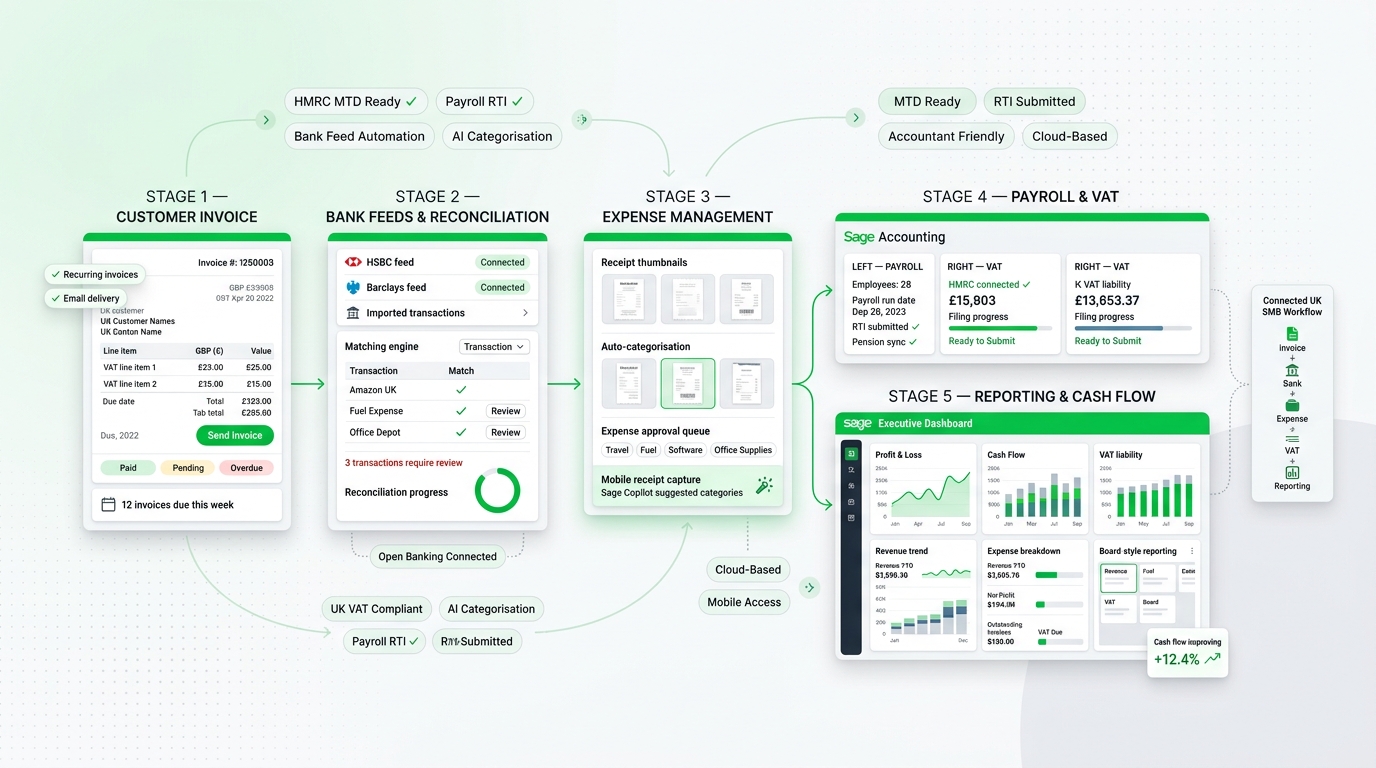
Sage Accounting helps businesses manage core finance tasks in one place. Instead of keeping separate spreadsheets for invoices, payments, VAT, and reports, the software gives businesses a central system for recording and reviewing financial activity.
The platform is particularly useful for businesses that want better visibility over money coming in, money going out, unpaid invoices, and tax-related records.
Create and send invoices to customers.
Connect bank accounts and review transactions.
Track payments and outstanding invoices.
Keep VAT records more organised.
View reports for business performance.
Give accountants cleaner financial information.
Who Sage Accounting is suitable for
Sage Accounting is suitable for businesses that need more than a simple invoice generator but do not yet need a full enterprise finance system.
Business type | Why it may fit | What to check before choosing |
|---|---|---|
Sole traders | Useful for invoices, expenses, bank records, and simple reporting. | Check whether the plan includes all features needed for tax and record keeping. |
Small limited companies | Good for businesses that need VAT support, reporting, accountant access, and better bookkeeping structure. | Check user access, purchase invoice features, and reporting needs. |
Service businesses | Works well for companies that send invoices regularly and need to monitor unpaid customer balances. | Check quote, invoice, and cash flow features. |
Growing SMEs | Useful when spreadsheets are becoming slow, risky, or difficult to manage. | Check whether the business may need stock, multi-currency, or more advanced reporting. |
Sage Accounting pricing and plans
Sage Accounting is usually offered in three main plan levels: Accounting Start, Accounting Standard, and Accounting Plus. The exact price may change depending on current promotions, billing terms, and Sage’s latest pricing updates.
Before publishing pricing on a live website, always check Sage’s official pricing page because software prices and offers can change.
Plan | Indicative monthly price | Best suited to | Typical use case |
|---|---|---|---|
Accounting Start | From around £12 + VAT per month | Sole traders and very small businesses | Basic accounting, invoicing, bank connection, VAT support, reports, and mobile access. |
Accounting Standard | From around £24 + VAT per month | Small businesses needing fuller accounting workflows | More complete bookkeeping, quotes, purchase invoices, statements, and cash flow tools. |
Accounting Plus | From around £30 + VAT per month | Growing businesses with more advanced needs | Stock items, multi-currency support, budgeting, and broader finance controls. |
Pricing should be treated as a guide only. Confirm current pricing, plan limits, discounts, and VAT details directly with Sage before making a purchase decision.
Key features
Invoicing
Sage Accounting allows businesses to create and send invoices, track whether customers have paid, and keep invoice records connected to the wider accounting system. This is helpful for businesses that currently use separate invoice templates and manual payment trackers.
Bank connections
Bank connection features can reduce manual data entry and make it easier to match transactions. For small businesses, this can save time and reduce mistakes compared with copying bank activity into spreadsheets.

VAT support
VAT is one of the main reasons UK businesses choose structured accounting software. Sage Accounting includes VAT-related functionality, making it relevant for
VAT-registered businesses and businesses preparing for digital tax workflows.
Reports
Reports help owners understand sales, expenses, cash flow, unpaid invoices, and wider business performance. This is useful when a business wants to make decisions based on current numbers rather than waiting until year-end.
Mobile access
Mobile access is useful for business owners who need to review records, check invoices, or manage simple finance tasks while away from a desk.
Plan feature comparison
The right Sage Accounting plan depends on how much functionality the business needs. A very small business may only need simple invoicing and records, while a growing business may need more users, purchase workflows, stock items, or multi-currency features.
Feature area | Start | Standard | Plus |
|---|---|---|---|
Sales invoicing | Included | Included | Included |
Bank connection | Included | Included | Included |
VAT support | Included | Included | Included |
Reports | Included | Included | Included |
Quotes and estimates | Limited or not the main focus | Included | Included |
Purchase invoices | Limited or not the main focus | Included | Included |
Stock items | Not included | Not included | Included |
Multi-currency | Not included | Not included | Included |
Budgeting | Not included | Not included | Included |
Strengths
Sage Accounting’s main strength is that it gives small businesses a structured and recognisable accounting system without immediately moving them into complex enterprise software.
Strong brand recognition in UK business accounting.
Useful everyday features for invoices, VAT, bank records, and reports.
Clear plan structure for different business sizes.
Suitable for businesses moving away from spreadsheets.
Part of a wider Sage ecosystem for payroll, HR, and business management.
Limitations
Sage Accounting is not the cheapest possible tool for every business, and some features sit behind higher plan levels. Businesses should compare the plan carefully against their actual needs before subscribing.
Some advanced features are only available on higher plans.
Very simple businesses may not need all the functionality.
Growing companies with complex reporting may eventually need a more advanced product.
Businesses should check current feature limits before choosing a plan.
When Sage Accounting makes sense
Sage Accounting makes sense when a business has started to outgrow manual bookkeeping or disconnected tools. It is a practical choice when financial admin is becoming time-consuming and the business needs a more reliable way to manage records.
The business sends invoices regularly.
The owner wants better visibility over unpaid customer balances.
The business needs VAT support and cleaner records.
Bank transaction matching would save time.
The accountant needs more organised information.
The business wants software from an established accounting brand.
When it may not be the right fit
Sage Accounting may not be the best fit for businesses that only need a very basic invoice tool or businesses that already require complex operational software.
Larger or more complex businesses may need to look beyond entry-level accounting software if they require advanced inventory, multi-entity reporting, approval workflows, manufacturing processes, or deeper financial management.
Which plan should a business choose?
Business situation | Possible plan fit | Reason |
|---|---|---|
Simple sole trader | Accounting Start | A practical entry point for basic invoices, bank records, VAT-related tasks, and reports. |
Small company with regular bookkeeping needs | Accounting Standard | Better for businesses that need quotes, purchase invoices, statements, and fuller accounting workflows. |
Growing business with stock or international activity | Accounting Plus | More suitable if the business needs stock items, multi-currency features, or budgeting. |
Operationally complex company | Consider a larger Sage product | Businesses with advanced stock, multi-entity, ERP, or finance team requirements may need a more advanced system. |
Final verdict
Sage Accounting is a strong option for UK small businesses that want a reliable cloud accounting platform with practical tools for invoicing, VAT, bank transactions, reporting, and everyday bookkeeping.
It is especially useful for businesses that want to move away from spreadsheets and build a cleaner finance workflow. The software is not necessarily the cheapest choice for every very small business, but it offers a more structured accounting environment than basic invoice-only tools.
For sole traders and very small businesses, Accounting Start may be enough. For small companies with broader bookkeeping needs, Accounting Standard is likely to be more practical. For growing businesses that need stock items, multi-currency support, or budgeting, Accounting Plus may be the better fit.
Frequently asked questions
Is Sage Accounting good for small businesses?
Yes. Sage Accounting is designed for small businesses that need cloud-based tools for invoices, bank transactions, VAT, reports, and day-to-day bookkeeping.
Is Sage Accounting suitable for sole traders?
It can be suitable for sole traders, especially those who want invoicing, bank records, reports, and more organised financial admin. Very simple businesses should still compare the plan features against their actual needs.
Does Sage Accounting support VAT?
Sage Accounting includes VAT-related functionality, making it relevant for VAT-registered businesses and businesses that want more structured digital records.
Does Sage Accounting include multi-currency?
Multi-currency features are generally associated with the higher-level Accounting Plus plan. Businesses that invoice internationally should confirm the current feature list before choosing a plan.
Is Sage Accounting better than spreadsheets?
For many growing businesses, yes. Spreadsheets can work in the early stage, but accounting software can reduce manual work, improve record keeping, and give clearer financial visibility.