
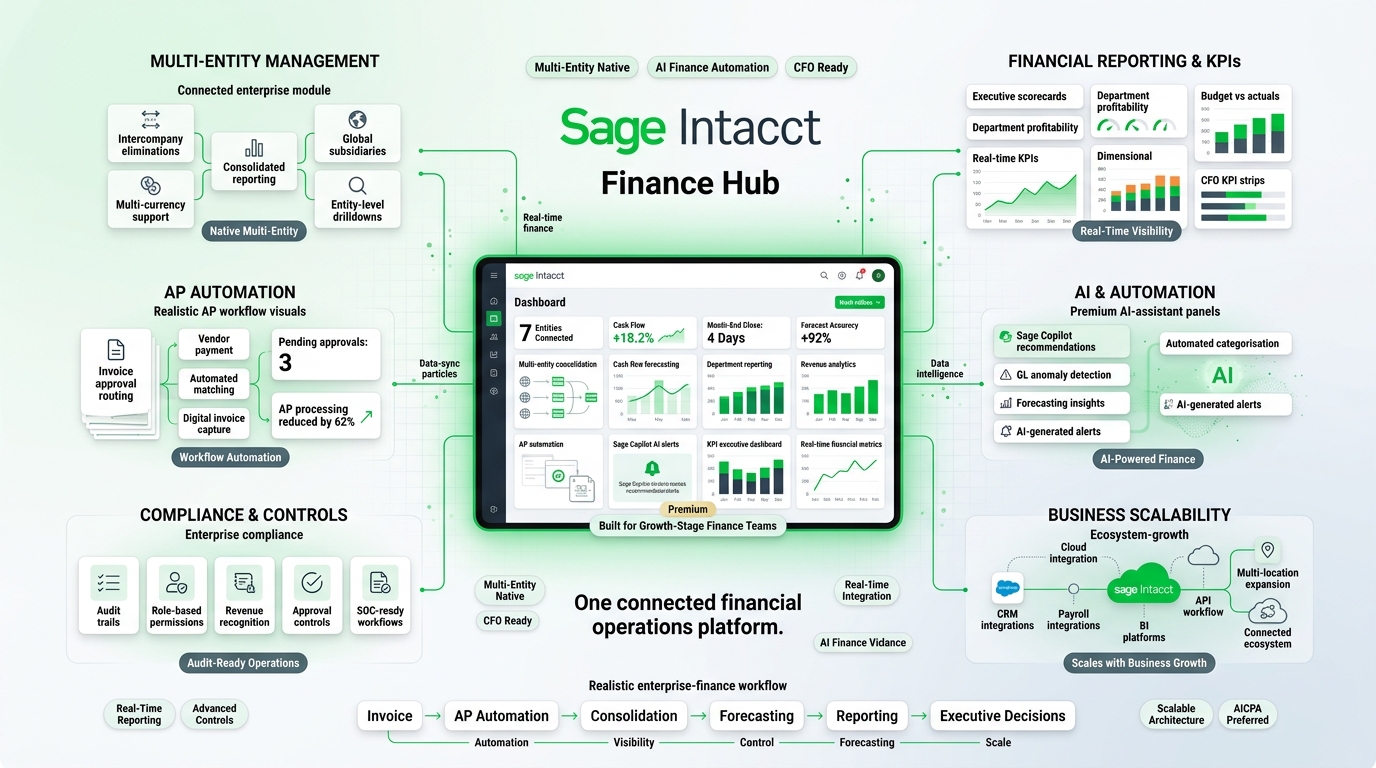
Sage Intacct is the cloud financial management platform Sage positions at UK mid-market finance teams who have outgrown small business accounting and want automation, multi-entity consolidation, and serious reporting depth without stepping up to a full Tier 1 ERP. In 2026 it is also Sage’s most AI-forward product, with a network of finance agents and Sage Copilot included.
Sage Intacct sits in a very specific place in the Sage UK portfolio. It is not the right product for sole traders, freelancers, or early-stage limited companies — those businesses are served by Sage Accounting, Sage Sole Trader, or Sage 50. Sage Intacct is aimed at UK organisations with more complex finance needs: multi-entity groups, subscription and SaaS businesses, professional services firms, financial services companies, charities and non-profits, hospitality groups, and growing healthcare providers.
This review looks at Sage Intacct through a UK lens: what the product actually does in 2026, how its AI agents and Sage Copilot are positioned, how it handles Making Tax Digital and FRS 102, indicative UK pricing ranges, implementation realities, and where it is genuinely a strong fit compared to the alternatives UK finance leaders typically consider.
Best for
UK mid-market finance teams — multi-entity groups, SaaS/subscription businesses, professional services firms, financial services, and charities that need strong reporting, consolidation, and compliance control.
Not ideal for
Sole traders, freelancers, and small businesses under roughly 50 staff. They are better served by Sage Accounting, Sage Sole Trader, Sage 50, or Sage 200.
Core strength
Cloud-native financial management with multi-dimensional reporting, multi-entity consolidation, and an expanding suite of AI agents (AP Automation, Close, Assurance, Time, Finance Intelligence) through Sage Copilot.
Pricing style
Quote-based per-user annual subscription. Public indicative UK ranges sit broadly between £30,000 and £300,000 per year for the licence plus implementation, depending on user count and modules.
UK compliance
Making Tax Digital for VAT, UK GAAP (FRS 102), multi-GAAP for IFRS, multi-currency, UK bank feeds with major clearing banks, and integration with Sage Payroll or third-party UK payroll for PAYE/RTI.
Verdict
One of the strongest cloud financial management platforms available to UK mid-market businesses in 2026. Worth shortlisting alongside NetSuite and Microsoft Dynamics 365 Business Central if your priority is finance depth and reporting, not manufacturing or heavy supply-chain operations.
What is Sage Intacct?
Sage Intacct is a cloud-native financial management and accounting platform from Sage Group plc, the FTSE 100 software company headquartered in Newcastle upon Tyne. Intacct was originally developed in the United States and acquired by Sage in 2017, and since then it has been progressively localised for the UK and Irish markets. In 2026 Sage positions Intacct as its flagship AI-powered finance platform for mid-sized organisations.
The platform is delivered as software-as-a-service and, for UK customers, is hosted in the AWS London region. It is designed around a multi-dimensional general ledger, which is a meaningful difference from smaller accounting products. Instead of forcing finance teams to encode department, location, project, fund, and class information into the chart-of-accounts numbering, Intacct lets those attributes live as separate reporting dimensions. In practice that makes reporting faster to build, easier to slice, and less fragile over time.
Sage describes Intacct on its UK site as finance software built to close books faster with trusted AI, and it highlights that more than 200,000 growing and mid-sized businesses use Sage finance software globally. The UK positioning centres on three claims in 2026: automating between 50 and 90 per cent of repetitive finance work, delivering measurable return on investment inside six months, and reducing month-end close time significantly for customers who adopt the AI agents.
It is worth being specific about what Sage Intacct is not. It is not a full manufacturing ERP, it is not a sole-trader bookkeeping app, and it is not a direct replacement for Sage 50 or Sage Accounting. It is a finance platform for organisations where the finance team owns real complexity: multiple entities, inter-company transactions, grant or fund accounting, subscription revenue recognition, project profitability, or FRS 102 consolidated reporting.
Who Sage Intacct is built for in the UK
Sage Intacct is typically a good fit for UK organisations in the roughly 50 to 2,000 employee range, or with finance teams large enough that spreadsheet-heavy processes have started to slow down month-end and decision-making. The product is industry-focused, and the Sage UK site calls out specific verticals with tailored capability: construction, financial services, healthcare, hospitality, professional services, SaaS and subscription businesses, wholesale distribution, non-profits, and manufacturing-adjacent use cases.
The strongest matches we see consistently in the UK market are:
Professional services firms that bill by time, project, or retainer and want connected project accounting, time capture, and WIP reporting alongside the ledger.
SaaS and subscription businesses that need recurring billing, contract-based revenue recognition under IFRS 15, and MRR/ARR reporting in the same system as the general ledger.
Charities and non-profits requiring fund accounting, grant tracking, restricted and unrestricted fund reporting, and Charity SORP-aligned outputs.
Financial services and professional services groups with multiple legal entities, inter-company flows, and the need for consolidated management and statutory reporting.
Hospitality and multi-site groups that need location-level P&L without rebuilding the chart of accounts every time a new site opens.
Organisations with heavy manufacturing, distribution, or complex supply-chain needs usually look at Sage X3, Microsoft Dynamics 365 Business Central or Finance & Operations, or NetSuite instead. Sage Intacct can participate in those environments, but its centre of gravity is finance, not production control.
UK pricing
Sage does not publish a price list for Sage Intacct in the UK. Pricing is quote-based and depends on the number and type of users, the mix of modules, add-on industry extensions, transaction volumes, and whether you buy direct from Sage or through a Sage UK implementation partner. Independent UK research sources give a reasonable range to work with when scoping, but any number you see online should be treated as indicative and confirmed in your own quote.
Based on current UK market data, the following bands are a realistic planning starting point:
Deployment size | Indicative UK subscription | Indicative implementation | Typical profile |
|---|---|---|---|
Smaller (20–50 users) | £30,000–£70,000 per year | £20,000–£50,000 one-off | Single entity or small group, core financials plus one or two modules. |
Mid-size (50–150 users) | £70,000–£150,000 per year | £40,000–£100,000 one-off | Multi-entity group, advanced reporting, project accounting or revenue recognition. |
Larger (150–500 users) | £150,000–£300,000 per year | £80,000–£200,000 one-off | Complex group, extensive integrations, full suite including procurement and planning. |
A few points every UK buyer should factor into their model:
User tiering matters. Full users (finance team, power users) carry a higher per-user cost than limited users (approvers, timesheet submitters, expense claimants). Get the mix right or you will over-licence.
Annual billing is standard. Intacct is typically quoted annually in advance, not monthly.
Implementation is a real line item. Configuration, data migration, integrations, training, and go-live support are usually delivered by a Sage UK partner and priced separately from the licence.
Marketplace add-ons can add cost. Third-party integrations, industry extensions, and connectors are sometimes priced on top.
Practical note on pricing: When you request a quote, ask for a three-year total cost of ownership including the licence uplift each year, professional services for go-live, expected change-request budget in year one, and any industry module you know you will need. Sage Intacct projects very rarely come in below the indicative ranges once all of that is counted.
Sage has also launched Sage Intacct Essentials for the UK market — a simpler, monthly-priced tier aimed at growing businesses that have outgrown spreadsheets and starter products but are not yet ready for the full Intacct footprint. It is the natural stepping-stone product if the full platform looks over-scoped for where the business sits today.
All figures above are indicative UK market ranges from independent research at the time of writing and are published for planning purposes only. Always verify pricing directly with Sage or a Sage UK partner before signing.
Core financial management capability
The heart of Sage Intacct is its general ledger and core financial management suite. For UK finance leaders evaluating the platform against alternatives, the functionality that matters most tends to fall into the following areas.
General ledger and multi-dimensional accounting
Intacct’s multi-dimensional general ledger is the feature most experienced users highlight. Instead of forcing department, site, project, fund, or channel into the account code, those attributes sit as independent dimensions against each transaction. Reports can then be sliced by any combination of dimensions without restructuring the chart of accounts. This is the single biggest reason Intacct tends to win against smaller accounting products for growing finance teams.
Accounts payable and accounts receivable
AP supports UK payment methods including BACS, Faster Payments, and Direct Debit. AR supports automated dunning, aged-debt analysis, and recurring billing for subscription businesses. AP Automation has been significantly strengthened by the AI agent layer in 2026, which we cover below.
Multi-entity consolidation
Unlimited entities within a single instance, inter-company transactions with automated elimination entries, multi-currency consolidation, and multi-GAAP support so a UK group can maintain FRS 102 books alongside IFRS for reporting to overseas parents or investors. This is a genuine differentiator against smaller accounting platforms and is often the reason UK groups migrate off Xero or QuickBooks once they have more than two or three trading entities.
Cash management and UK bank connectivity
Cash management handles bank statement import in BAI2 and MT940 formats with automated reconciliation, and bank feeds connect to major UK clearing banks including Barclays, HSBC, Lloyds, NatWest, and Santander. For finance teams spending hours on reconciliation inside spreadsheets, this alone often justifies part of the business case.
Fixed assets
Fixed-asset management is UK-aware, with support for capital allowances, the Annual Investment Allowance, and standard depreciation schedules.
Reporting and dashboards
Reporting is widely cited by Sage Intacct customers as a stand-out capability. Dashboards refresh in real time, reports can be drilled from summary down to source transaction, and finance teams can collaborate and annotate reports inside the platform. Spreadsheet users get a bridge through Sage Intacct Collaborate, which extends Excel into the Intacct reporting model so board packs and management accounts can be maintained without manual exports. Sage customers publicly cite reductions in month-end close time of 75 per cent and genuine real-time visibility across departments.
AI agents and Sage Copilot
The biggest 2026 story around Sage Intacct is how much of the product now runs on AI. Sage has moved beyond a single AI assistant and delivered a network of specialist finance agents. In the UK they are marketed as part of Sage Copilot and are included with Sage Intacct at no separate licence cost.
Agent | What it does | Why UK finance teams care |
|---|---|---|
AP Automation agent | Reads incoming bills, matches to purchase orders, flags duplicates, and creates draft bills for approval with high accuracy. | Removes the repetitive part of purchase-invoice entry and raises control over duplicate payments. |
Close agent | Tracks the month-end close, flags bottlenecks, and keeps the team on schedule against the close calendar. | Shortens the close cycle and makes ownership of tasks visible without spreadsheets. |
Assurance agent | Scans journal entries as they are posted to detect anomalies, duplicates, and unusual transactions in the general ledger. | Raises the bar on controls and reduces the risk of errors and fraud reaching the trial balance. |
Finance Intelligence agent | A generative assistant that answers natural-language questions about reports, balances, and transactions in the platform. | Turns ad-hoc management requests into a conversation instead of a spreadsheet rebuild. |
Time agent | Pulls meetings, emails, and document signals to suggest timesheet entries for professional services users. | Improves project cost accuracy and removes friction from utilisation tracking. |
The practical effect of the AI layer is that the product is starting to feel less like a traditional general ledger and more like a finance platform that actively works on your behalf between month-ends. The automation claims Sage publishes — 50 to 90 per cent of AP work automated, close cycles reduced materially, 5x ROI within six months — need to be stress-tested in your own pilot, but the capability is genuinely in the product rather than a roadmap promise.
Sage Intacct Data Cloud
For finance teams who want to push Intacct data into their own analytics stack, Sage Intacct Data Cloud — announced as part of the 2026 release — provides direct, governed access to Intacct data in Snowflake. That matters for UK groups who are standardising on a cloud data warehouse and want finance data to flow in cleanly alongside operational data.
UK regulatory compliance
Compliance is where a mid-market finance platform either earns trust or loses it quickly, and Sage Intacct has done the work that UK buyers expect. The three things worth checking in detail in any procurement process are MTD, UK GAAP, and VAT treatment.
Making Tax Digital for VAT
Sage Intacct supports HMRC’s Making Tax Digital programme. Digital record-keeping lives inside the platform, VAT returns are prepared against the nine-box template, and submission to HMRC is made either through direct API integration or an approved bridging route. Digital links are maintained throughout the record-keeping chain, as HMRC requires. Always confirm the specific submission method with your Sage UK implementation partner at scoping — the exact configuration can vary by partner and setup.
UK GAAP (FRS 102)
Statutory reporting under FRS 102 is supported, including the Reduced Disclosure Framework for qualifying entities, Section 1A small entities reporting, and multi-GAAP operation for groups that also report under IFRS. For charity clients, configurations exist to support Charity SORP reporting, and several UK Sage Intacct partners specialise in the third sector.
VAT treatment
Intacct handles the full range of UK VAT codes: standard, reduced, zero, exempt, and outside the scope. It supports partial exemption calculations, the flat-rate scheme, and the domestic reverse charge for construction (CIS). For UK-based groups that trade into the EU post-Brexit, the multi-currency and multi-entity engine handle realised and unrealised FX, period-end revaluation, and multi-currency bank accounts without manual journals.
Payroll and pensions
Sage Intacct does not include native UK payroll. Most UK customers integrate with Sage Payroll or a third-party UK payroll provider for PAYE RTI submissions, statutory pay, workplace pension auto-enrolment, and P60/P11D outputs. That is the standard pattern for cloud financial management platforms at this tier and is not a weakness unique to Intacct, but it is worth remembering in scoping.
Industries where Sage Intacct is a strong fit
Sage markets Sage Intacct against specific UK industry needs, and the configurations, reporting templates, and partner specialisms line up with the following sectors particularly well.
Professional services
Time capture, project budgeting, WIP and revenue recognition, utilisation reporting, and client-profitability analysis. Pairs well with Sage Intacct’s project accounting module. This is one of the most common UK buying profiles.
SaaS and subscription
Contract-based recurring billing, IFRS 15 revenue recognition, deferred-revenue tracking, and ARR/MRR reporting inside the same ledger used for statutory accounts. This is where Sage Intacct consistently outperforms smaller accounting products.
Charities and non-profits
Fund accounting, grant management, restricted and unrestricted fund reporting, and Charity SORP alignment. Several UK partners specialise in this sector, which matters because the configurations are non-trivial.
Financial services
Multi-entity consolidation, inter-company eliminations, FRS 102 and IFRS reporting, and dimensional analysis by product line, fund, or client. A common match for asset managers, wealth groups, and fintechs beyond start-up stage.
Hospitality and multi-site retail
Site-level P&L, consolidated reporting across venues, and cash-flow visibility across a group. A reasonable fit once a hospitality group has outgrown Sage 50 or Xero and needs proper group-level reporting.
Healthcare
Private clinics, group practices, and growing care providers use Intacct where multi-entity structure, grant management, and referral-partner reporting matter.
Construction
Project accounting, job-level profitability, retention handling, and CIS-aware VAT treatment. Heavier construction buyers sometimes move to Sage 200 or Sage X3 instead; Intacct is the right choice when finance depth and reporting outweigh trade-contractor workflow needs.
Sage Intacct Essentials
For UK businesses that like Sage Intacct but are not ready for a full implementation, Sage now offers Sage Intacct Essentials. It is positioned as a simpler, faster-to-deploy, monthly-priced entry to the Intacct platform for organisations that have outgrown spreadsheets and starter accounting products but are not yet running complex multi-entity structures or advanced revenue recognition.
Essentials is a pragmatic middle step. It keeps many of the Intacct design principles — multi-dimensional reporting, cloud-native delivery, Sage Copilot — in a smaller configuration that growing businesses can live on before they need the full platform. For Sage it also protects the upgrade path: an Essentials customer can graduate into the full Intacct product without changing vendor, losing historical data, or re-platforming.
Implementation and UK partners
Sage Intacct is almost always implemented by a Sage UK partner rather than directly by Sage. That choice matters more than the licence choice for long-term success. A typical UK implementation runs 3–6 months from kick-off to go-live. Simpler single-entity deployments with only core financials can complete in 8–12 weeks. Complex multi-entity, multi-integration programmes can take 6–9 months.
Known UK implementation partners with proven Sage Intacct delivery credentials include Acuity Solutions, Percipient, Azets, PKF Smith Cooper, Datel, and BDO. The right partner for you depends on your industry and the complexity of your environment, not on who has the largest brand.
When selecting a partner, ask specifically about:
Industry references of similar size and complexity.
Number of Sage Intacct certified consultants on staff.
Their configuration, data migration, and cutover methodology.
Post-go-live managed service and helpdesk arrangements.
Their change-request process and hourly rates.
Whether they can deliver FRS 102, SORP, or IFRS templates out of the box.
Integrations and ecosystem
Sage Intacct has an open API and an app marketplace that covers CRM (including Salesforce, which Sage highlights as a deep integration), expenses, travel and expense, AP automation, procurement, treasury, subscription billing, data warehousing, and reporting tools. UK customers commonly integrate to banking providers for bank feeds, to HMRC for VAT submission, to payroll for PAYE, and to a cloud data warehouse such as Snowflake for analytics.
The platform is stronger as a finance spine than it is as a full operational ERP. For businesses with heavy production, shop-floor, or warehouse needs, Sage Intacct typically sits as the finance layer while operations are run in another system. That architecture is common and supported, but it does mean UK buyers should plan integration effort, not just licence cost.
Pros and cons of Sage Intacct
Pros
Genuine cloud-native financial management built for UK mid-market complexity.
Multi-dimensional general ledger removes the need to overload the chart of accounts.
Strong multi-entity consolidation with automated inter-company eliminations.
Advanced reporting widely regarded as best-in-class for the mid-market.
Network of AI agents (AP, Close, Assurance, Time, Finance Intelligence) included through Sage Copilot.
UK-localised: MTD, FRS 102, UK VAT schemes, GBP base currency, UK bank feed support.
Strong fit for professional services, SaaS, non-profits, financial services, and hospitality groups.
Sage Intacct Essentials gives a realistic on-ramp for growing UK businesses not yet ready for the full platform.
Mature UK partner ecosystem with specialists per industry.
Cons
Not a fit for sole traders, freelancers, or very small businesses — overkill and over-priced for that profile.
Pricing is opaque. You need a quote, and the real number depends on partner, modules, and users.
No native UK payroll. Requires integration with Sage Payroll or a third-party provider.
Not the strongest choice for heavy manufacturing or supply chain — Sage X3 or Microsoft Dynamics 365 may fit better.
Implementation is a project, not an onboarding. Budget properly for partner services.
Some advanced modules (order management, procurement, planning) sit on top of the core and add cost.
Sage Intacct vs the alternatives UK buyers usually consider
Most UK finance leaders evaluating Sage Intacct also look at at least one of Sage 200, NetSuite, Microsoft Dynamics 365 Business Central, and Xero. A very quick orientation:
Platform | Target profile | When it wins over Sage Intacct |
|---|---|---|
Sage 200 | UK-focused mid-market generalist with integrated payroll. | Stronger if integrated UK payroll, basic manufacturing, or simpler UK-only scope is the priority. |
Oracle NetSuite | Global cloud ERP for mid-market and upper mid-market. | Wins when global subsidiaries, e-commerce, and operational ERP depth outweigh pure finance-reporting needs. |
Microsoft Dynamics 365 Business Central | Cloud ERP with tight Microsoft 365 integration. | Attractive for Microsoft-standardised mid-market businesses that want finance plus light operations. |
Xero / Sage Accounting | UK small business accounting. | The right choice below roughly 50 staff or where multi-entity complexity does not yet exist. |
Sage Intacct usually wins when the buyer’s priority is finance depth — multi-entity reporting, revenue recognition, project accounting, dimensional analysis, AI-driven close — and the operational ERP surface area can either be kept simple or integrated to a specialist system.
Who should choose Sage Intacct
Sage Intacct is the right call if two things are true. First, finance complexity is real: multiple entities, real consolidation requirements, subscription or project revenue, or fund accounting. Second, the finance team has enough weight and ambition to own a proper cloud finance platform rather than a starter tool. When both are true, Intacct consistently ranks among the best cloud financial management products available to UK mid-market businesses in 2026.
It is not the right call if the business is still small, transactions are simple, and spreadsheets plus a smaller product like Sage Accounting, Xero, or Sage 50 are keeping up. Over-buying Intacct for that profile leads to slow adoption, wasted licence spend, and a finance team that feels the tool is heavier than the business.
Where we would recommend Sage Intacct: a UK group with three or more entities, real consolidation needs, a finance team of at least five, and a priority on reporting depth and close speed. Where we would recommend holding off: single-entity UK businesses under 50 staff where Sage Accounting, Sage 50, or Xero are still working.
Final verdict
Sage Intacct is a mature, cloud-native, UK-localised financial management platform that in 2026 has been aggressively upgraded with AI agents and Sage Copilot. It is one of the strongest options available to UK mid-market finance leaders who want serious reporting, multi-entity consolidation, and automated close — and it is clearly the platform Sage itself is investing behind for that segment.
The product is not for everyone. It is not a fit for sole traders, freelancers, or small businesses, and it is not a replacement for heavy operational ERP in manufacturing or distribution. Buyers who try to use it outside its sweet spot tend to regret it.
For the right UK organisation — a mid-market group with real finance complexity, a finance team ready to invest in a platform, and a preference for AI-led automation over manual month-end work — Sage Intacct deserves a place on the shortlist alongside NetSuite and Microsoft Dynamics 365. The combination of multi-dimensional reporting, multi-entity consolidation, FRS 102 and MTD support, and a genuinely growing agent network makes it a strong long-term home for UK finance.
As with any mid-market finance platform, the decision comes down to quote, partner, and fit. Run a structured evaluation, involve the partner in a demo against your own chart of accounts and reporting pack, and make sure the three-year total cost of ownership is understood before signing.
Frequently asked questions
Is Sage Intacct available in the UK?
Yes. Sage Intacct has been localised for the UK market and is sold and supported by Sage UK and an established UK partner network. UK data is hosted in the AWS London region, the platform uses GBP as a base currency, and it supports UK VAT, UK bank formats, and FRS 102 reporting.
How is Sage Intacct different from Sage 50 or Sage Accounting?
Sage Accounting and Sage 50 are aimed at sole traders and small businesses. Sage Intacct is a cloud financial management platform for UK mid-market organisations with multi-entity structures, complex reporting, revenue recognition, or consolidation needs. Businesses typically move to Sage Intacct when the finance requirements have outgrown what a small business accounting product can deliver.
Does Sage Intacct support Making Tax Digital?
Yes. Sage Intacct supports Making Tax Digital for VAT, including digital record-keeping, nine-box VAT return preparation, and submission to HMRC either through direct API integration or an approved bridging route. Confirm the exact submission method with your Sage UK implementation partner.
How much does Sage Intacct cost in the UK?
Sage does not publish a UK price list for Sage Intacct. Indicative UK market ranges place the annual subscription broadly between £30,000 and £300,000 per year depending on user count and modules, with implementation typically adding £20,000 to £200,000 one-off. Always confirm with a direct quote.
Does Sage Intacct include payroll?
No. Sage Intacct does not include native UK payroll. Most UK customers integrate with Sage Payroll or a third-party UK payroll provider to handle PAYE RTI, statutory pay, workplace pension auto-enrolment, and year-end returns.
How long does a UK implementation take?
A typical UK Sage Intacct implementation runs 3–6 months from kick-off to go-live. Simpler single-entity deployments using only core financials can go live in 8–12 weeks. Complex multi-entity projects with extensive integrations can take 6–9 months.
What industries is Sage Intacct best suited to in the UK?
Sage highlights construction, financial services, healthcare, hospitality, professional services, SaaS and subscription, wholesale distribution, and non-profit. The strongest UK adoption is in professional services, SaaS, non-profits, financial services, and multi-site hospitality groups.
What is Sage Intacct Essentials?
Sage Intacct Essentials is a simpler, monthly-priced version of Sage Intacct aimed at growing UK businesses that have outgrown spreadsheets and entry-level tools but are not yet ready for a full Sage Intacct implementation. It provides a practical on-ramp to the platform with a clear upgrade path.
How does Sage Intacct compare to NetSuite or Microsoft Dynamics 365?
Sage Intacct is typically the stronger choice when the priority is finance depth, multi-entity consolidation, and reporting. NetSuite is often preferred for global, heavily operational cloud ERP deployments, and Microsoft Dynamics 365 is attractive for mid-market businesses already standardised on Microsoft 365. All three are valid shortlisting candidates for UK mid-market finance projects.