
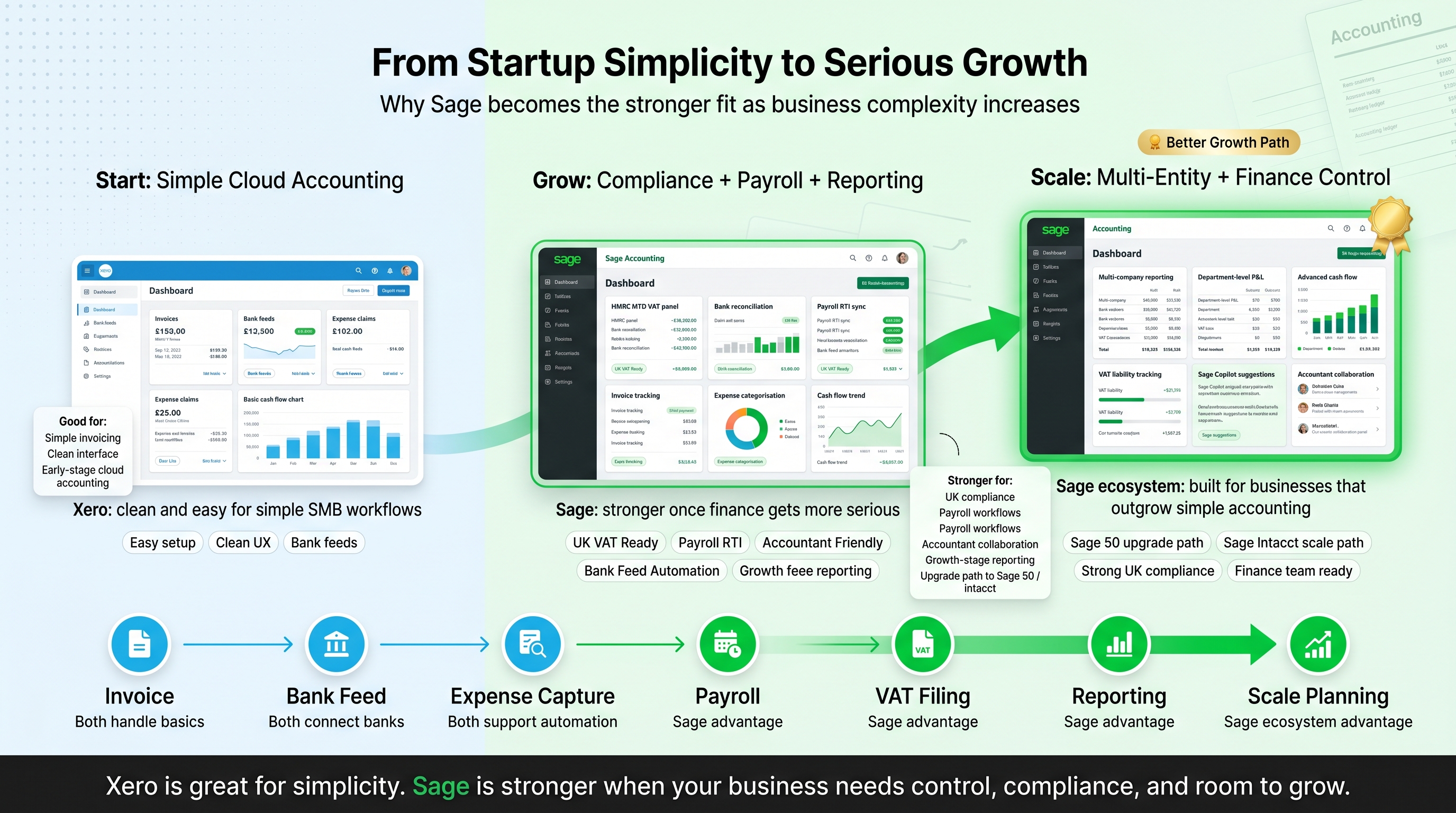
Sage and Xero are two of the best-known accounting software options for UK small businesses. Both help with invoicing, bank reconciliation, VAT, reporting, and day-to-day financial admin, but they are not built for exactly the same type of business.
Sage is often attractive to businesses that want a structured accounting platform from a long-established finance software provider. Xero is often popular with businesses that want a clean online accounting experience, a wide app ecosystem, and strong collaboration with accountants and bookkeepers.
The right choice depends on how your business works. A sole trader with simple invoices will compare these tools differently from a VAT-registered limited company, a growing service business, or an SME that may later need payroll, inventory, multi-currency support, or more advanced reporting.
Best overall fit
Sage is strong for businesses that want structured finance workflows and a wider Sage product ecosystem. Xero is strong for businesses that want a modern cloud accounting experience with broad third-party app connections.
Best for Sage
UK SMEs that value established accounting software, VAT support, reporting, Sage Copilot, payroll availability, and a route into broader Sage products as they grow.
Best for Xero
Small businesses and accountants that prefer a highly cloud-native interface, strong app marketplace, and flexible plan options across different business stages.
Main decision
Choose based on workflow fit, plan features, accountant preference, VAT needs, integrations, and whether your business may later need deeper finance or operations software.
Quick comparison
Sage and Xero cover many of the same accounting basics, but the user experience, plan structure, ecosystem, and upgrade path are different. This table gives a simple overview before going into the details.
Area | Sage Accounting | Xero |
|---|---|---|
Best known for | Established accounting software, VAT support, reporting, Sage Copilot, and wider Sage business products. | Modern cloud accounting, clean interface, accountant collaboration, and strong app ecosystem. |
Typical users | Sole traders, small limited companies, VAT-registered businesses, and growing SMEs. | Sole traders, small businesses, startups, accountants, bookkeepers, and growing teams. |
UK VAT support | Available across Sage Accounting Start, Standard, and Plus. | Available across relevant Xero plans, with Making Tax Digital support highlighted across the UK product experience. |
Pricing style | Three main tiers: Start, Standard, and Plus. | Multiple tiers including Simple, Ignite, Grow, Comprehensive, and Ultimate. |
Advanced needs | Plus adds stock, multi-currency, budgets, and more advanced controls. Larger businesses can explore other Sage products. | Higher Xero plans add broader functionality such as payroll, expenses, projects, analytics, and scaling tools depending on plan. |
Best reason to choose | You want a structured UK accounting platform with a strong finance software heritage and room to grow within Sage. | You want an easy cloud accounting workflow with a broad app marketplace and accountant-friendly collaboration. |
Pricing comparison
Pricing is one of the first things businesses compare, but it should not be the only factor. A cheaper plan may not be cheaper in practice if it lacks the features your business needs, such as purchase invoices, multi-user access, payroll, stock, multi-currency, or deeper reporting.
Sage currently presents its main Accounting plans as Start, Standard, and Plus. Sage pages also reference an offer of three months free followed by £18, £39, or £59 plus VAT per month depending on tier. Xero UK has moved to a newer plan structure, with Simple, Ignite, Grow, Comprehensive, and Ultimate. Xero’s own pricing update page states that from 1 September 2025 the UK prices are £7, £16, £37, £50, and £65 per month excluding applicable taxes, depending on plan.
Provider | Plan | Listed monthly price | Best suited to |
|---|---|---|---|
Sage | Accounting Start | £18 + VAT per month after current offer period | VAT-registered sole traders and small businesses getting started with cloud accounting. |
Sage | Accounting Standard | £39 + VAT per month after current offer period | Small businesses needing fuller accounting workflows, multi-user access, quotes, purchase invoices, and cash flow forecasting. |
Sage | Accounting Plus | £59 + VAT per month after current offer period | Businesses needing stock items, multi-currency, budgets, and more advanced analysis. |
Xero | Simple | £7 per month excluding applicable taxes | Non-VAT registered businesses with basic accounting needs, such as sole traders and landlords. |
Xero | Ignite | £16 per month excluding applicable taxes | Businesses that need an easy financial foundation with essential cash flow and accounting features. |
Xero | Grow | £37 per month excluding applicable taxes | Small businesses that need more room than entry-level accounting plans provide. |
Xero | Comprehensive | £50 per month excluding applicable taxes | Businesses that need broader features across accounting and business management workflows. |
Xero | Ultimate | £65 per month excluding applicable taxes | Larger employers and more complex small businesses needing advanced tools and analytics. |
Pricing changes frequently because of promotions, offer periods, tax treatment, and plan updates. Always confirm current pricing directly with Sage and Xero before making a purchase decision or publishing a live comparison.
Feature comparison
Both Sage and Xero cover the core accounting features most small businesses expect. The difference is usually in how features are packaged, how the workflow feels, and which advanced features are included at each plan level.
Feature | Sage Accounting | Xero |
|---|---|---|
Invoicing | Included across core Sage Accounting plans. | Included, with some lower-tier limits depending on plan. |
Bank reconciliation | Bank connection and transaction review included across core plans. | Bank reconciliation included across accounting plans. |
VAT support | VAT support is listed across Start, Standard, and Plus. | Xero supports VAT workflows and is positioned around Making Tax Digital readiness in the UK. |
Reports | Reports and insight included across plans, with more advanced analysis available on higher tiers. | Reports are available, with more advanced analytics and forecasting depending on plan. |
Multi-user access | Available from Standard and Plus. | Available across Xero’s broader cloud accounting experience, depending on plan and user setup. |
Stock or inventory | Stock items are available on Accounting Plus. | Inventory capability depends on plan and may also be extended through apps. |
Multi-currency | Available on Accounting Plus. | Available on selected higher plans. |
AI support | Sage Copilot is listed across Start, Standard, and Plus. | Xero has been developing AI-supported tools, including JAX, across its product experience. |
App ecosystem | Connected Sage ecosystem plus Sage Marketplace options. | Strong third-party app marketplace and accountant/bookkeeper ecosystem. |
Where Sage is stronger
Sage is a strong choice for businesses that want accounting software from a provider with a long history in finance and business management. It is particularly appealing if the business wants a more structured accounting environment and may later need payroll, HR, or more advanced Sage products.
Strong recognition in UK accounting and finance software.
Clear Start, Standard, and Plus plan structure.
Sage Copilot is listed across the main Accounting plans.
VAT, reports, bank connection, and mobile access are listed across core plans.
Accounting Plus includes stock items, multi-currency invoicing and banking, financial budgets, and analysis types.
Useful upgrade path into wider Sage products for growing businesses.
Sage may be the better fit when the business wants a finance-focused platform with a clear path from small business accounting into broader business software. This matters for companies that expect their needs to become more complex over time.
Where Xero is stronger
Xero is a strong choice for businesses that prefer a modern cloud-first accounting experience. It is popular with accountants and bookkeepers, and its app marketplace is one of the main reasons many small businesses consider it.
Clean cloud accounting experience that many users find approachable.
Broad plan structure for different business stages.
Strong accountant and bookkeeper ecosystem.
Large third-party app marketplace.
Useful for businesses that want flexible integrations with other tools.
Simple plan available for non-VAT registered businesses with basic needs.
Xero may be the better fit when a business values a large app ecosystem, prefers Xero’s interface, or already works with an accountant who uses Xero heavily.
Ease of use
Both platforms are built to make accounting easier than manual spreadsheets, but the feel is different. Xero is often seen as very cloud-native and lightweight in presentation. Sage has a more structured finance software feel, which some businesses prefer because it can make accounting workflows feel more controlled.
The best way to judge ease of use is not by screenshots alone. A business should test the tasks it actually performs every week:
Creating an invoice.
Matching a bank transaction.
Checking unpaid customer balances.
Reviewing a profit and loss report.
Preparing VAT records.
Adding an accountant or team member.
Finding help when something goes wrong.
VAT and Making Tax Digital
VAT is one of the biggest reasons UK businesses choose proper accounting software. Both Sage and Xero are relevant options for businesses that need digital record keeping and VAT workflows.
Sage lists VAT support across Accounting Start, Standard, and Plus. Xero also focuses heavily on Making Tax Digital readiness in its UK product experience. For a VAT-registered business, the practical decision should come down to which system makes the VAT process clearer, easier to review, and easier to share with an accountant.
Practical point: Do not choose accounting software only because it can send invoices. For UK businesses, VAT handling, digital records, bank reconciliation, reports, and accountant collaboration are often more important over the long term.
Accountant and bookkeeper collaboration
Many UK small businesses choose accounting software based on what their accountant prefers. This is sensible because the software will often be used by both the business and the accountant.
Xero has a very strong accountant and bookkeeper community. Sage also has a major accountant-focused ecosystem and offers products for accountants and their clients. If your accountant already works mainly with one platform, that can make setup, training, and year-end work easier.
Before choosing, ask your accountant:
Which platform do they work with most often?
Can they help migrate data?
Which plan do they recommend for your business?
How will they access your records?
Will they help with VAT setup and reporting?
Integrations and ecosystem
Xero is especially well known for its app marketplace. This can be useful if your business uses several tools for payments, ecommerce, CRM, stock, time tracking, expenses, or reporting.
Sage also has a wider ecosystem, but its strength is slightly different. Sage can be attractive if the business wants to stay within a finance and operations software family as it grows, including payroll, HR, financial management, and more advanced business systems.
Business need | Likely better fit | Reason |
|---|---|---|
Many third-party app integrations | Xero | Xero is particularly strong for businesses that rely on a wide app marketplace. |
Structured accounting and finance workflow | Sage | Sage has a strong finance software heritage and clear accounting plan structure. |
Future payroll, HR, or broader business software needs | Sage | Sage has a wider product ecosystem beyond small business cloud accounting. |
Accountant already works in Xero | Xero | Using the same platform as your accountant can simplify collaboration. |
Stock and multi-currency in accounting plan | Sage Plus or higher Xero plans | Both can support more advanced needs, but check exact plan details before choosing. |
Sage vs Xero for sole traders
Sole traders usually need simple invoicing, expense tracking, bank reconciliation, income tax readiness, and clear records. Xero’s Simple plan is positioned for non-VAT registered businesses with basic accounting needs, which can make it attractive for sole traders and landlords.
Sage Accounting Start may be more suitable for sole traders who want a more structured Sage accounting environment, especially if they are VAT registered or expect to grow into fuller small business accounting workflows.
For sole traders, the best choice often depends on whether the business is VAT registered, how many invoices it sends, whether an accountant is involved, and how much functionality is needed beyond basic records.
Sage vs Xero for small limited companies
Small limited companies usually have more accounting requirements than very simple sole traders. They may need purchase invoices, accountant access, VAT returns, cash flow visibility, supplier records, customer statements, and better management reports.
Sage Accounting Standard and Plus become more relevant here because Standard adds features such as multi-user access, cash flow forecasts, quotes and estimates, purchase invoices, and statements. Plus adds stock items, multi-currency invoicing and banking, financial budgets, and analysis types.
Xero’s Grow, Comprehensive, and Ultimate plans may also be suitable depending on whether the business needs more features such as payroll, expenses, projects, analytics, or wider app integrations.
Sage vs Xero for growing SMEs
Growing SMEs should think beyond what they need today. The business may later need payroll, stock, multi-currency, more users, approvals, deeper reporting, or even a more advanced finance system.
Sage may be more attractive if the business wants an accounting product that sits inside a wider Sage ecosystem. Xero may be more attractive if the business wants broad app flexibility and a cloud-first accounting workflow that many accountants already support.
Choose Sage if the business wants structured finance workflows and a possible path into wider Sage products.
Choose Xero if the business values app ecosystem, cloud usability, and accountant collaboration.
Compare higher plans carefully if stock, multi-currency, payroll, expenses, or analytics matter.
Pros and cons of Sage
Pros
Established brand in accounting and business software.
VAT support, reports, bank connection, mobile app, and Sage Copilot listed across core accounting plans.
Clear upgrade path from Start to Standard to Plus.
Useful for businesses moving away from spreadsheets.
Wider Sage ecosystem can support more advanced needs later.
Cons
Entry pricing may feel higher than very basic tools.
Some important features are only on Standard or Plus.
Businesses that depend heavily on third-party apps may prefer Xero’s marketplace.
Very simple sole traders may not need the full Sage experience.
Pros and cons of Xero
Pros
Modern cloud accounting experience.
Strong accountant and bookkeeper ecosystem.
Broad app marketplace.
Multiple plan options for different stages.
Simple plan can suit non-VAT registered businesses with basic needs.
Cons
Some plans have usage limits or feature packaging that must be checked carefully.
Higher plans can become more expensive as needs grow.
Businesses may need extra apps for certain workflows.
Not every accountant or business owner prefers Xero’s workflow.
Which one should you choose?
Sage and Xero are both credible accounting software choices. The better option depends on your business stage, workflow, and future needs.
Choose Sage if... | Choose Xero if... |
|---|---|
You want accounting software from a long-established finance software provider. | You want a cloud-native accounting experience with a strong app ecosystem. |
You want Sage Copilot included across the core Sage Accounting plans. | You want to use Xero’s cloud accounting workflow and connected app marketplace. |
You may later need Sage Payroll, Sage HR, Sage 50, Sage 200, or Sage Intacct. | Your accountant or bookkeeper already works heavily with Xero. |
You want a clear Start, Standard, and Plus structure. | You want more plan levels, including an option for non-VAT registered businesses with basic needs. |
You prefer a structured finance software environment. | You prefer a flexible cloud accounting ecosystem with many third-party integrations. |
Final verdict
Sage is a strong choice for UK small businesses that want structured accounting software, VAT support, bank connection, reporting, Sage Copilot, and a route into a wider business software ecosystem. It is especially worth considering if the business wants to grow from basic accounting into more complete finance workflows over time.
Xero is a strong choice for businesses that want a modern cloud accounting platform, broad app connections, and a large accountant and bookkeeper ecosystem. It is especially useful for companies that want flexible integrations and an interface many small business owners find approachable.
For very simple non-VAT registered businesses, Xero’s lower-cost Simple plan may be attractive. For VAT-registered small businesses that want a structured Sage environment, Sage Accounting Start may be a better starting point. For growing SMEs, the decision should come down to whether Sage’s wider product path or Xero’s app ecosystem better matches the business.
Frequently asked questions
Is Sage better than Xero?
Sage may be better for businesses that want a structured accounting system from an established finance software provider with a wider Sage product ecosystem. Xero may be better for businesses that want a cloud-first interface and strong third-party app integrations.
Is Xero cheaper than Sage?
Xero has lower entry pricing for some businesses, especially with the Simple plan for non-VAT registered users. However, higher Xero plans can increase in cost as the business needs more features. Sage’s main Accounting plans currently sit at £18, £39, and £59 plus VAT per month after the offer period.
Which is better for VAT-registered UK businesses?
Both Sage and Xero can be suitable for VAT-registered UK businesses. Sage lists VAT support across Start, Standard, and Plus, while Xero also focuses on Making Tax Digital readiness. The better choice depends on workflow, accountant preference, reporting needs, and plan features.
Which is better for sole traders?
Xero’s Simple plan may suit non-VAT registered sole traders with basic needs. Sage Accounting Start may suit sole traders who want a more structured accounting platform, especially if they are VAT registered or expect to grow.
Which is better for growing businesses?
Sage may be stronger if the business wants a wider route into payroll, HR, finance, and business management products. Xero may be stronger if the business values app integrations and accountant collaboration.
Should I ask my accountant before choosing?
Yes. Your accountant or bookkeeper may have a strong preference, and choosing a platform they already know can make setup, VAT returns, reporting, and year-end work easier.