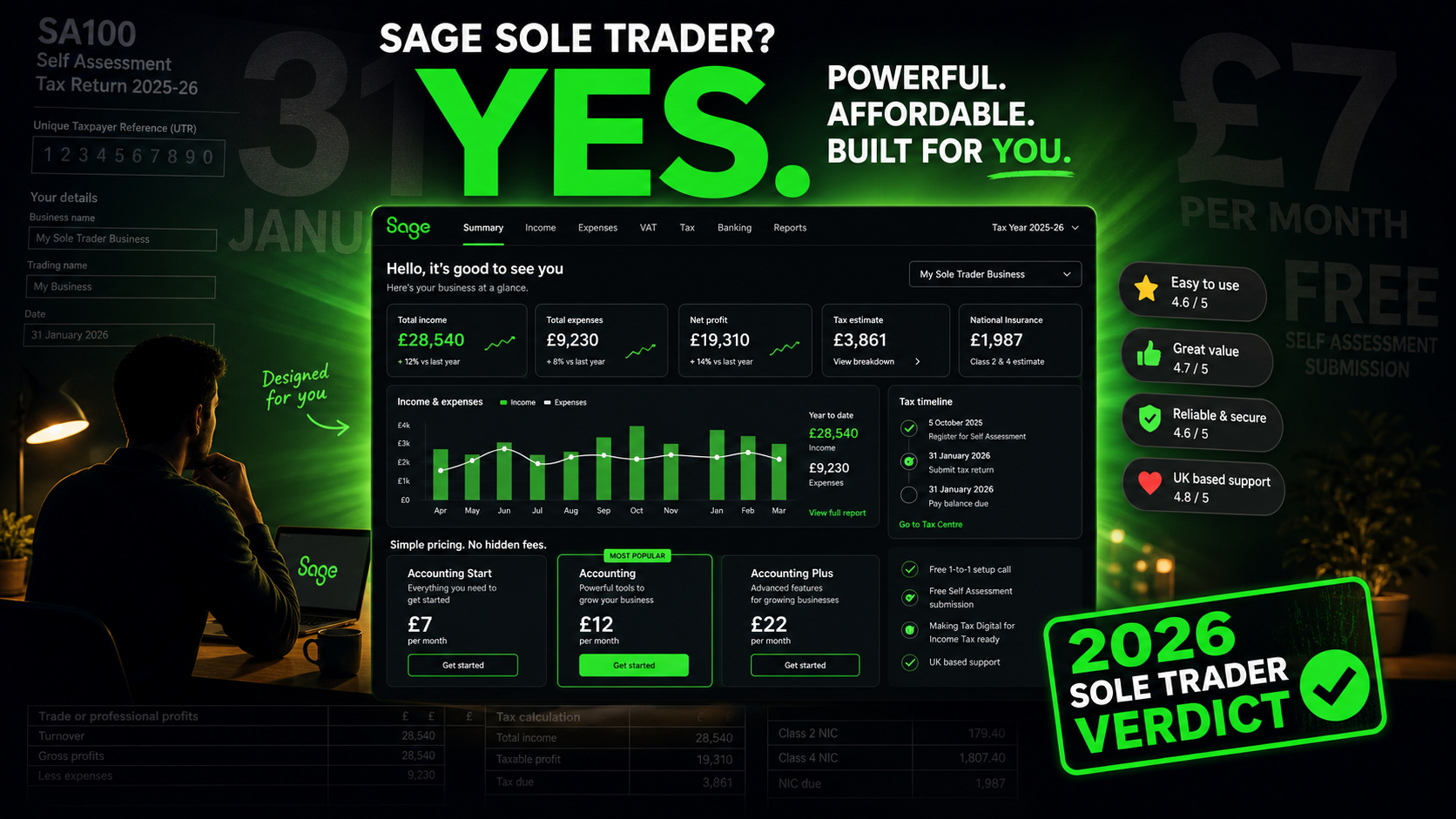
Most articles about accounting software for UK sole traders were written for a world that no longer exists. They compare plans based on features that a freelancer or self-employed tradesperson will never use, quote prices from the full business accounting suite rather than the entry-level options actually designed for sole traders, and then conclude with a verdict that assumes the reader has a small business with employees, inventory, and multiple revenue streams. The reality of most UK sole traders is simpler than that — and so is the decision.
Sage now has a dedicated sole trader product that most reviews have not yet caught up with: Sage Sole Trader, starting at £0 per month on the free tier and £7 per month on the paid tier, built specifically for non-VAT-registered self-employed people who need digital records, Self Assessment support, and MTD for Income Tax readiness without the complexity or cost of full business accounting software. Alongside that sits Sage Accounting Start at £18 per month for VAT-registered sole traders and those who need invoicing as part of their workflow. This article gives an honest, current answer to whether Sage is worth it for UK sole traders in 2026 — who it suits, who it does not, and what the right plan is for each situation.
The Thing Most Sole Traders Get Wrong About Accounting Software
The most common mistake UK sole traders make when evaluating accounting software is choosing based on the wrong question. The question they ask is “which software has the best features?” The question they should be asking is “what do I actually need to stay legally compliant and financially organised as a sole trader in 2026?” Those are different questions, and they lead to very different answers.
As a sole trader, your core obligations are specific and relatively contained: keep accurate records of your income and expenses, file a Self Assessment tax return by 31 January each year, pay Income Tax and National Insurance on your profits, and — from April 2026 if your qualifying income is above £50,000, or from later phases if it is lower — comply with MTD for Income Tax by keeping digital records and submitting quarterly updates to HMRC. If you are VAT-registered, you also need to file quarterly VAT returns through MTD-compliant software. That is the list. Everything beyond that list is convenience, efficiency, or competitive advantage — valuable, but secondary to the compliance foundation.
The right accounting software for a sole trader is the one that satisfies those obligations completely, at the lowest cost and complexity that still gives you confidence the job is done correctly. For a non-VAT-registered sole trader with straightforward income, that is a very different product from what a limited company with employees needs. Sage now builds that distinction into its product range explicitly, which is why the sole trader conversation in 2026 looks different from any previous year.
The Sage Sole Trader Plan: What Was Actually Just Launched
Sage Sole Trader is a dedicated product for non-VAT-registered self-employed individuals, sole traders, and landlords. It is not a stripped-down version of Sage Accounting. It is a separate product, available as a mobile app on iOS and Android as well as a web interface, designed around the specific workflow of a self-employed person managing their own records without accounting knowledge.
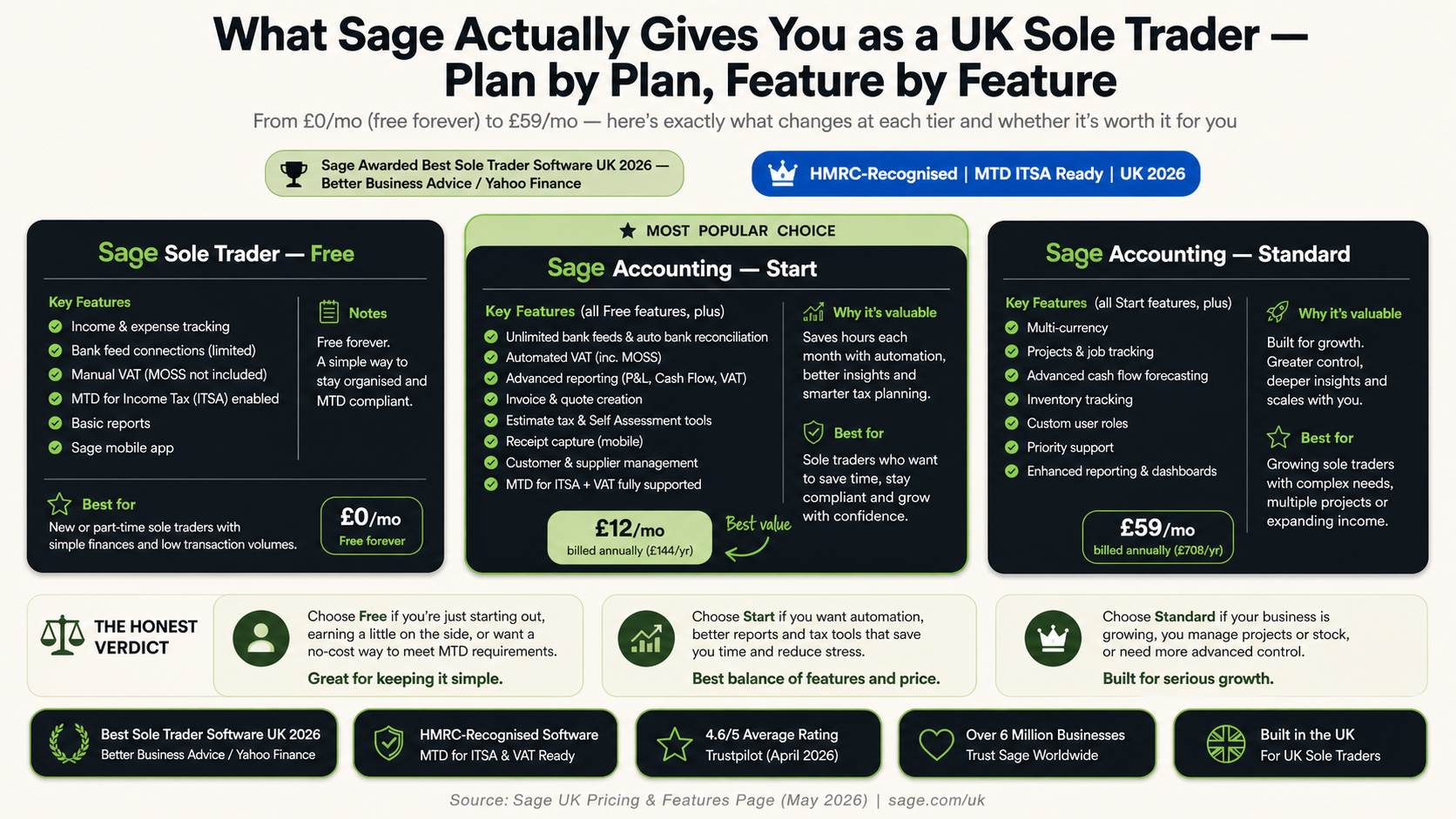
The product has two tiers: a free tier and a paid tier at £7 per month (excluding VAT), both currently with three months free for new users. The free tier — Sole Trader Free — covers the basics that HMRC requires: digital record-keeping, income and expense tracking, and Self Assessment preparation. The paid tier adds automation, bank feeds, receipt scanning, MTD for Income Tax quarterly update submission, and a cleaner workflow for people who want to spend the minimum possible time on their finances each week. For accountants managing client sole traders, both tiers are available through the Sage for Accountants platform, with the free tier at £0 per client and the paid tier at £7 per client per month.
The pricing that changes the conversation
Sage Sole Trader at £7 per month is 23 pence per day. The minimum HMRC penalty for a single day of non-compliant digital record-keeping under MTD for Income Tax is £5. A sole trader in scope for MTD from April 2026 who remains non-compliant for one month faces a potential penalty of £150 — more than five months of the paid Sage Sole Trader subscription. At that ratio, the question of whether Sage is “worth it” answers itself before any efficiency or time-saving benefit is even considered.
The Full Sage Sole Trader Range: Every Option and Its Price
Product | Monthly Price (excl. VAT) | 3 Months Free? | Who It Is For | MTD Covered |
|---|---|---|---|---|
Sage Sole Trader — Free | £0/mo | N/A — always free | Non-VAT-registered sole traders who need basic digital records and Self Assessment prep | Digital record-keeping for MTD IT; Self Assessment reporting; quarterly update preparation |
Sage Sole Trader — Paid | £7/mo | ✅ 3 months free, then £7/mo | Non-VAT-registered sole traders wanting automation, bank feeds, receipt capture, and direct MTD IT quarterly update submission | Full MTD for Income Tax — digital records, quarterly updates submitted to HMRC, Self Assessment, bank feed, receipt scanning |
Sage Accounting — Start | £18/mo | ✅ 3 months free, then £18/mo | VAT-registered sole traders; sole traders who send regular invoices to clients and need professional invoicing tools | MTD for VAT (digital records, digital link, HMRC submission) + MTD for Income Tax; bank feeds; 1 Copilot user |
Sage Accounting — Standard | £39/mo | ✅ 3 months free, then £39/mo | Sole traders with employees, more complex VAT, or cash flow forecasting needs; those wanting receipt capture included | MTD VAT + MTD IT + receipt capture (30 included) + cash flow forecasting + additional Copilot users |
Sage Accounting — Plus | £59/mo | ✅ 3 months free, then £59/mo | Sole traders with inventory, multi-currency transactions, or complex reporting requirements | Everything in Standard + inventory + multi-currency + 100 receipt captures included |
The tier structure answers a question that has previously made Sage feel inaccessible to sole traders: “do I really need to pay £18 a month when I am just a freelancer?” In 2026 the honest answer is: probably not, unless you are VAT-registered or you invoice clients frequently and want the professional invoicing workflow. For most non-VAT-registered sole traders, the Sage Sole Trader paid tier at £7 per month — or even the free tier — covers everything the law requires and everything practical financial management needs.
Non-VAT-Registered Sole Trader: Which Sage Plan Is Right
The majority of UK sole traders are not VAT-registered. The current VAT registration threshold is £90,000 in taxable turnover. The Federation of Small Businesses estimates that approximately 3.1 million UK sole traders are below that threshold and therefore have no VAT obligation. For this group, the choice within Sage is between the free Sole Trader tier and the £7 per month paid tier — and the decision comes down to three questions.
Are you in scope for MTD for Income Tax now or soon? If your qualifying income is above £50,000, you need the paid tier to submit quarterly updates directly to HMRC from April 2026. If your income is between £30,000 and £50,000, you need it from April 2027. If it is between £20,000 and £30,000, you need it from April 2028. The free tier prepares your records for MTD but requires the paid tier for actual HMRC quarterly update submission.
Do you want a bank feed? The paid tier connects to your bank account through open banking and imports transactions automatically. The free tier requires manual entry. If you have more than 20 transactions a month, the time saved by the bank feed alone is worth more than the £7 monthly cost within the first week of use.
Do you want to scan receipts rather than manually enter expenses? The paid tier includes receipt scanning via the mobile app. Point the camera at a receipt, the data is extracted and categorised automatically. The free tier requires manual expense entry. For tradespeople, contractors, or anyone with regular physical receipts, this feature eliminates a task that is tedious and error-prone in any manual system.
For a non-VAT-registered sole trader with straightforward income and below the current MTD Income Tax threshold, the free tier is a genuinely complete solution for basic compliance. For anyone above the £50,000 qualifying income threshold, or anyone who values the time saving of automation, the paid tier at £7 per month is the right choice — and it is hard to construct a scenario where that cost is not recovered immediately in reduced admin time and penalty risk avoided.
VAT-Registered Sole Trader: Why Start at £18/Mo Makes Sense
If you are VAT-registered, the Sage Sole Trader product is not the right fit. VAT-registered businesses need MTD for VAT compliance — digital records, unbroken digital link, and HMRC-recognised software submission — which is not covered by the Sole Trader product. For a VAT-registered sole trader, the entry point is Sage Accounting Start at £18 per month, and it is worth understanding exactly what that covers.
What £18/mo gets you
Full MTD for VAT compliance — digital records, digital link, direct HMRC submission via API; no bridging software required
MTD for Income Tax quarterly updates — built in for when you enter scope
Automated bank feeds via open banking — transactions imported daily, no manual statement download
Professional invoicing — create, send, and track invoices; payment status visible in real time
Real-time profit and loss, balance sheet, and VAT liability reports available at any point during the period
Sage Copilot AI (1 user) — transaction categorisation suggestions, anomaly detection, cash flow alerts
HMRC deadline reminders built into the platform — no separate diary management required
Full audit trail of all transactions and submissions — exportable for accountant or HMRC inspection
Six-year cloud record retention — automatic, no manual backup or file management
What you would pay otherwise
Bridging software for MTD VAT: £10–£20/mo from most providers — already more than Sage Start for VAT alone
Invoicing software (e.g. basic Invoice Ninja or FreshBooks): £10–£15/mo separately
Bookkeeper to maintain manual records: £15–£30/hr; even 2 hours/month = £30–£60/mo
Year-end accountant fee for a client with messy records vs clean Sage records: difference typically £150–£400 per year
HMRC late filing penalty (1 missed VAT deadline): £200 fixed penalty minimum
HMRC broken digital link penalty: £5–£15 per day while non-compliant
Time cost of manual reconciliation: average 120 hours per year for manual bookkeeping users
The Honest Comparison: Sage vs the Alternatives
The “worth it” question only has meaning in relation to the alternatives. For UK sole traders in 2026, the realistic alternatives to Sage are: staying on spreadsheets, using a free tool like Wave or HMRC’s Basic PAYE Tools, using a competitor like FreeAgent, Xero, or QuickBooks, or doing nothing and hoping HMRC’s enforcement does not reach them before they figure out a system. Each of those deserves an honest assessment.
Option | Cost | MTD IT Compliant? | MTD VAT Compliant? | Honest Assessment for Sole Traders |
|---|---|---|---|---|
Sage Sole Trader Free | £0/mo | ⚠️ Records only; quarterly update submission needs paid tier | ❌ Not for VAT-registered | Genuinely good for non-VAT sole traders below MTD threshold who need basic organised records and Self Assessment prep |
Sage Sole Trader Paid | £7/mo | ✅ Full — quarterly updates submitted to HMRC | ❌ Not for VAT-registered | Best-value fully compliant option for non-VAT sole traders; bank feed + receipt scanning + MTD IT for 23p/day |
Sage Accounting Start | £18/mo | ✅ Full | ✅ Full | Right choice for VAT-registered sole traders; invoicing + MTD VAT + MTD IT + Copilot AI in one platform |
FreeAgent | £19/mo (or free with NatWest/RBS/HSBC) | ✅ Announced for MTD IT | ✅ Yes | Strong for contractors and freelancers; free via bank partnerships is excellent value; less construction/CIS depth than Sage |
QuickBooks Simple Start | £14/mo | ✅ MTD IT supported | ✅ Yes | Competitive on price; good mobile app; US-originated so some UK-specific nuances handled less natively than Sage |
Xero Starter | £16/mo | ✅ MTD IT supported | ✅ Yes | Good software; 20 invoices and 5 bills per month on Starter is restrictive for active sole traders; price rises sharply at next tier |
Excel / Spreadsheet | Included in Microsoft 365 (~£8/mo) | ❌ Cannot submit quarterly updates | ❌ Requires separate bridging software; broken digital links common | Works for record-keeping only; compliance gap grows with every new MTD obligation; 94% of business spreadsheets contain errors |
Do nothing / delay | £0/mo | ❌ | ❌ | Active HMRC enforcement; 5,500 new compliance staff added; £5–£15/day penalties accumulate from first day of obligation |
The honest position is that Sage is not the only good option for UK sole traders. FreeAgent, available free through certain bank accounts, is a genuinely strong alternative particularly for contractors. QuickBooks Simple Start at £14 per month is competitive for straightforward sole trader needs. But no competitor has a dedicated sole trader tier at £7 per month with full MTD Income Tax submission capability, bank feeds, and receipt scanning built into a product specifically designed for self-employed people rather than adapted from a small business suite. At that price point and that specificity, Sage Sole Trader is the most cost-accessible fully compliant sole trader accounting product in the UK market in 2026.
What the MTD for Income Tax Obligation Actually Means for Your Bill
MTD for Income Tax changes the frequency of interaction between a sole trader and their accounting records. Previously, a sole trader could manage perfectly well with records that were updated once a year in January before the Self Assessment deadline. Under MTD, records must be current enough to produce an accurate quarterly update by the 7th of the month following each quarter end. That deadline structure — four per year rather than one — means the records must be kept live throughout the year rather than reconstructed annually.
The practical consequence for sole traders is that the cost of sloppy record-keeping is no longer deferred until January. It compounds quarterly. A sole trader who falls three months behind on categorising expenses has a quarterly update deadline approaching with incomplete data. They can either submit inaccurate data and correct it later, miss the deadline and accumulate penalty points, or do three months of catch-up categorisation in the days before the deadline. All three options are worse than maintaining records as you go — which is exactly what Sage Sole Trader’s bank feed and receipt scanning make straightforward.
The time maths for a typical sole trader
A sole trader with 30 transactions per month using Sage Sole Trader Paid: bank feed imports all 30 transactions automatically, Copilot suggests categories for the recurring ones (typically 20 to 25 of the 30 after the first few months), and the user confirms or adjusts the remainder. Monthly bookkeeping time: approximately 10 to 15 minutes. Same sole trader without the bank feed, entering transactions manually: approximately 45 to 60 minutes per month. Annual time difference: 6 to 8 hours saved. At even a modest hourly rate of £20, that is £120 to £160 of time recovered each year from a £84/year subscription.
Who Sage Is Not Right For
An honest answer to whether Sage is worth it includes the cases where it is not. There are specific sole trader situations where a different tool, or a different Sage tier, is the more rational choice — and recommending Sage for everyone regardless of circumstances is not an honest position.
If your income is below £20,000 and you have no VAT registration — you will not enter MTD for Income Tax until April 2028 at the earliest, possibly never if the threshold remains at £20,000. The free Sage Sole Trader tier or a simple spreadsheet may be entirely adequate for your current obligations. The compliance urgency that makes paid accounting software compelling is lower at this income level.
If you bank with NatWest, Royal Bank of Scotland, or HSBC — FreeAgent is available free through these bank partnerships. Free is free. If FreeAgent’s feature set meets your needs, there is no financial argument for paying £7 per month for Sage Sole Trader over a free compliant alternative. Check whether your bank offers FreeAgent before choosing.
If you are a limited company director drawing salary and dividends with no self-employment income — you are not a sole trader. The Sage Sole Trader product does not apply to you. You need accounting software for a limited company, which is a different decision with different products and pricing.
If your sole trader business is dormant or about to close — maintaining accounting software for a business that is not trading is an unnecessary ongoing cost. Basic records and a final Self Assessment filing can be managed more cheaply in this situation.
If you already have a skilled accountant managing everything and have no desire to be involved in the day-to-day records — some sole traders prefer to hand everything to their accountant and receive a bill. If your accountant uses Sage for Accountants and manages your Sole Trader subscription on your behalf, the decision is theirs. If they use a different platform and it is working, there may be no reason to change.
The Verdict: Is Sage Worth It for UK Sole Traders in 2026?
The answer depends on which Sage product and which type of sole trader. But across the full range of common sole trader situations, the honest verdict is:
For a non-VAT-registered sole trader with qualifying income below £20,000: The free Sage Sole Trader tier is worth using as a better-organised alternative to a spreadsheet. It costs nothing and provides MTD-ready digital records. The paid tier is a reasonable upgrade if you value bank feed automation and receipt scanning, but it is not urgently necessary on a compliance basis until your income approaches the MTD threshold.
For a non-VAT-registered sole trader with qualifying income between £20,000 and £50,000: The paid Sage Sole Trader tier at £7 per month is the right preparation for MTD for Income Tax, which will apply to you between April 2027 and April 2028. At 23 pence per day, building the habit of digital record-keeping before the obligation becomes mandatory is the lowest-cost way to avoid the compliance scramble that catches most businesses off guard when a new tax obligation goes live.
For a non-VAT-registered sole trader with qualifying income above £50,000: You are in scope for MTD for Income Tax from April 2026. The paid Sage Sole Trader tier at £7 per month is the minimum compliant setup and the most cost-effective one available. It covers everything HMRC requires at a cost that is outweighed by a single day of non-compliance penalty.
For a VAT-registered sole trader: Sage Accounting Start at £18 per month is the right entry point. It covers MTD for VAT in full, handles MTD for Income Tax quarterly updates, provides professional invoicing, and includes Sage Copilot AI — all for less than the cost of bridging software plus basic invoicing from separate providers. The three months free offer means the first £54 of cost is deferred, and the audit trail and compliance confidence it provides will reduce year-end accountant fees by more than the annual subscription in most cases.
The broader honest answer is this: in 2026, with MTD for Income Tax live, HMRC enforcement increasing, and a compliance environment that penalises manual processes at £5 to £15 per day, accounting software is no longer a luxury for a UK sole trader. It is a compliance requirement. The question is not whether to have it, but which product at which price satisfies the obligation without overcomplicating a business that should stay simple. Sage has now built an explicit answer to that question into its product range: the Sole Trader product at £7 per month is that answer, built specifically for sole traders, and priced to make the cost objection genuinely difficult to sustain.