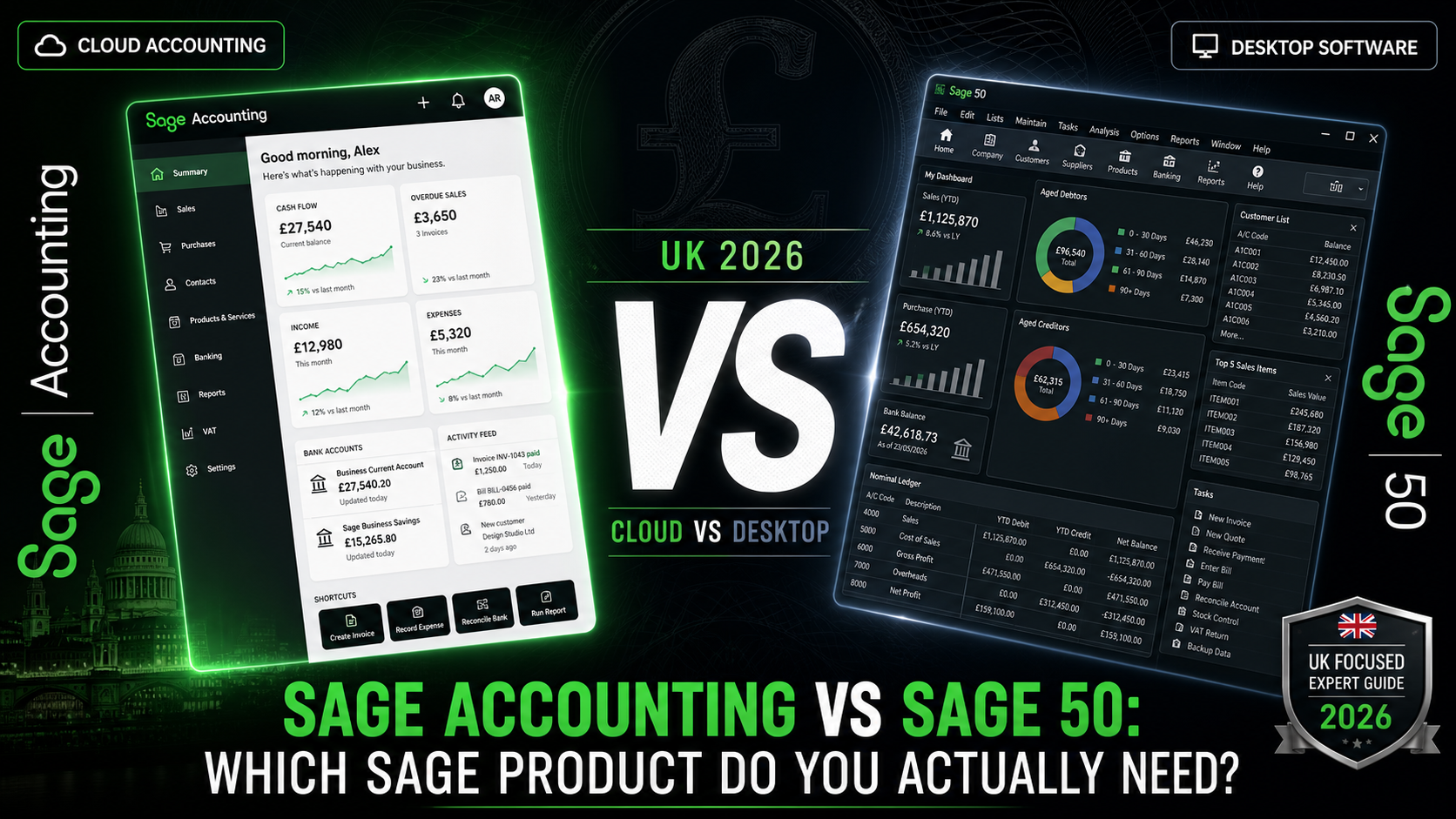
If you have been shopping for accounting software and arrived at the Sage product range, you have quickly realised there is more than one option with "Sage" in the name. Sage Accounting and Sage 50 are both made by the same company, both used extensively across UK small and medium-sized businesses, and both HMRC-recognised for Making Tax Digital. But they are not the same product, they are not priced remotely similarly, and they are not suited to the same kind of business.
The confusion is understandable. Sage's own marketing does not always make the distinction obvious, and accountants who use both products tend to speak about "Sage" as though it were one thing. It is not. Choosing the wrong one — and plenty of businesses do — means either paying significantly more than you need to, or buying software that cannot do what your business actually requires. This guide draws the distinction clearly.
What Each Product Actually Is
Sage Accounting — previously called Sage One — is a cloud-based accounting platform for small businesses and sole traders. It lives entirely in a browser. There is nothing to install, no server to maintain, and no local files to back up. Updates happen automatically, bank feeds connect via Open Banking, and the interface is designed to be accessible to business owners who are not accountants. It is available on plans ranging from a free Sole Trader tier up to Sage Plus.
Sage 50 is a different product with a different history and a different architecture. It was originally built as desktop software and has been progressively cloud-connected over the years without being rebuilt from scratch as a cloud-native platform. It is now available in cloud-hosted and on-premise variants, but its DNA is still that of a desktop accounts package: more powerful, more technically demanding, more expensive, and designed for businesses that have an accountant or finance manager using it regularly.
The fundamental distinction is this: Sage Accounting is software a business owner can run themselves. Sage 50 is software a finance professional runs on behalf of a business.
Pricing
The price gap between these two products is wide enough that it is often the deciding factor before any feature comparison is made.
Product & Plan | Monthly (excl. VAT) | Users | Best For |
|---|---|---|---|
Sage Accounting Free | £0 | 1 | Sole traders needing MTD for ITSA, invoicing, Copilot AI |
Sage Accounting Start | £18 | 1 | Small businesses needing bank feeds, VAT, MTD |
Sage Accounting Standard | £39 | Unlimited | Growing businesses needing payroll and CIS |
Sage Accounting Plus | £59 | Unlimited | Multi-currency, inventory, advanced budgeting |
Sage 50 Standard | from £77 | 2 core users | Small businesses needing detailed ledger control and reporting |
Sage 50 Professional | from £155 | Up to 20+ users | SMEs with complex transactions, multiple companies, advanced audit trails |
At the entry level, Sage Accounting at £18 per month and Sage 50 Standard from £77 per month are not comparable options for the same kind of business. The price difference reflects a genuine difference in what the product does, how it is deployed, and what level of accounting knowledge is required to operate it effectively. A small business spending £77 per month on Sage 50 when its actual needs are covered by Sage Accounting at £39 is spending almost double for capability it will never use.
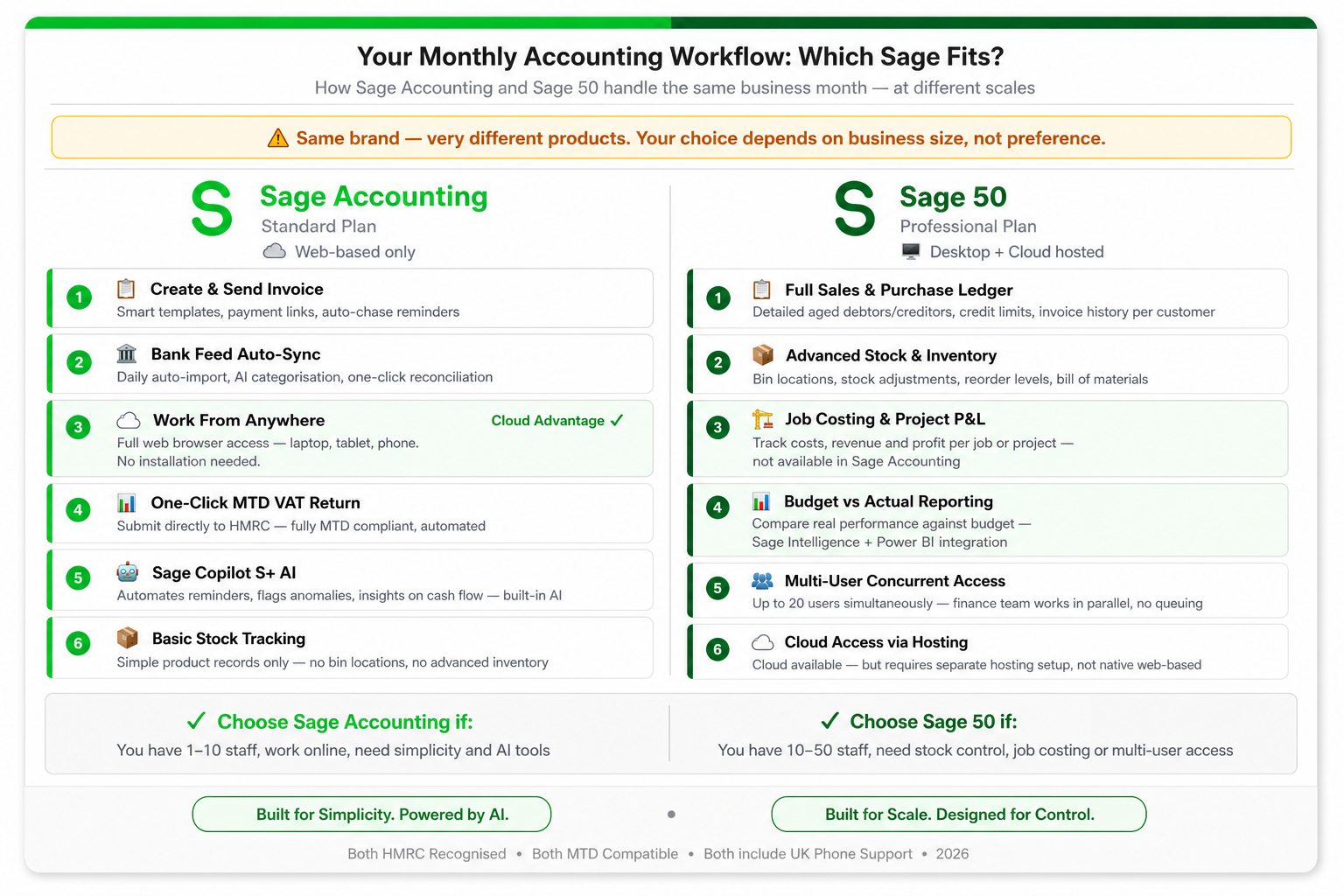
The number that matters
Sage 50 Professional's per-user pricing means that a finance team of five users can cost materially more per month than Sage Accounting Plus at £59 with unlimited users. The only reason to justify Sage 50's cost is that the business genuinely needs what Sage 50 provides — and most businesses do not.
Deployment and Architecture
This is a more technical dimension than most comparison guides go into, but it matters practically for how the two products behave in day-to-day use.
Sage Accounting is cloud-native. It runs in a browser on any device. Your data lives on Sage's servers, is backed up automatically, and is accessible from anywhere with an internet connection. Updates are applied by Sage without any action from you. You never install anything, never manage a database, and never worry about version control. For a small business without dedicated IT support, this is exactly the right architecture.
Sage 50 is more architecturally complex. In its cloud-connected form it uses a hybrid model — a local or hosted installation that synchronises with cloud infrastructure. The cloud-hosted option removes the need for a local server, but the product still behaves more like traditional desktop software in its data structure, file handling, and the way it manages concurrent users. This is not a weakness. It is the result of Sage 50 being built for accountants who benefit from that level of structure and control. But it does mean deploying and maintaining Sage 50 properly usually requires more technical competence than Sage Accounting.
For a business asking which one to buy, the architecture question becomes simple: do you have someone in the organisation who will actively manage the software, or does the business owner need something that runs with minimal overhead?
Accounting Depth and Complexity
Sage Accounting handles the needs of the overwhelming majority of UK small businesses. It covers double-entry bookkeeping, bank reconciliation, invoicing, purchase ledger, VAT returns, payroll, CIS, multi-currency, inventory management, and cash flow forecasting. It produces profit and loss statements, balance sheets, and the standard reporting most owner-managed businesses actually use.
Sage 50 handles everything Sage Accounting handles, plus a significant amount more. It gives you more granular nominal ledger control, deeper departmental and cost-centre reporting, stronger audit trails, more detailed stock functionality, and broader multi-company capability. Those are real advantages — but they only matter if the business genuinely needs that level of accounting infrastructure.
The practical question is whether a given business actually needs that depth. Most do not. A company that needs departmental profit and loss reporting, multi-entity management, or complex stock valuation does. A business that needs reliable accounts, accurate VAT returns, and payroll that works does not — and should not be paying for Sage 50 to get those things.
Reporting
Reporting is one of the clearest areas of functional separation between the two products.
Sage Accounting's reporting covers the standard management accounts suite well. Profit and loss, balance sheet, cash flow, VAT reports, aged debtors, and transaction-level summaries are all there. Analysis types on higher plans allow transactions to be tagged and filtered by custom dimensions such as department, location, or project. For most small businesses, this is sufficient and easy to work with.
Sage 50's reporting depth is significantly greater. It supports more detailed report customisation, deeper nominal-level analysis, stronger variance and budget reporting, and more sophisticated stock and project reporting. For an accountant producing management accounts for directors or a finance manager monitoring performance against budget, Sage 50 is the more capable tool. For a business owner who wants clear monthly accounts and a few good operational reports, it is usually more than necessary.
Payroll
Both products support payroll, but the structure is not the same.
Sage Accounting includes payroll natively on the Standard plan at £39 per month with no per-employee cost. RTI submissions to HMRC, statutory payments, auto-enrolment support, automatic tax code updates, and digital payslips are all included. For many growing small businesses, that makes Sage Accounting unusually cost-effective.
Sage 50's payroll is typically handled through Sage 50 Payroll, a separate but integrated product. That means the accounting subscription and payroll subscription are distinct. For businesses that already operate Sage 50 and want payroll journals posting directly into a detailed nominal ledger, this setup works well. But the additional cost is real. On payroll cost alone, Sage Accounting Standard is materially cheaper for most UK businesses with employees.
Making Tax Digital
Both products are HMRC-recognised for Making Tax Digital for VAT, and both support MTD for Income Tax Self Assessment from 2026 — but the implementation is not identical.
Sage Accounting includes Sage Copilot on every plan, including the free Sole Trader tier. Copilot helps prepare and submit quarterly MTD for Income Tax updates, flags anomalies, and is designed to reduce manual compliance effort. For sole traders and small business owners who want software to handle more of the compliance burden in the background, that is a meaningful advantage.
Sage 50 became MTD for Income Tax compliant from version 33.1 for subscription licence holders. It supports quarterly updates to HMRC for sole traders, with accountants able to submit on behalf of clients through Client Manager. The implementation is robust and appropriate for accountant-managed workflows. But Sage 50's MTD tooling is clearly built for more structured accounting environments, whereas Sage Accounting is designed to make compliance easier for owner-managed businesses directly.
Who Uses Each Product
Understanding the typical user of each product is often more useful than comparing feature lists, because the feature differences follow directly from who each product was built for.
Sage Accounting is used by business owners. The typical user is a sole trader, company director, or small business owner who does some or all of their own bookkeeping, works with an accountant at year-end, and needs software that does not require specialist accounting training to use properly. The interface and workflow are clearly built around that kind of user.
Sage 50 is used by accountants and finance managers. The typical user is an in-house accountant, employed bookkeeper, or external practice managing the ledger on behalf of a client. The software assumes a higher degree of comfort with nominal codes, ledger structures, and detailed accounting processes. For the right user, that is precisely the attraction. For the wrong user, it becomes unnecessary complexity very quickly.
Integration with Other Tools
Sage Accounting connects to a range of third-party tools through the Sage App Marketplace, including payment processors, e-commerce tools, and specialist business software. The ecosystem is smaller than some cloud-native competitors, but it covers the integrations most small businesses actually need.
Sage 50 integrates more deeply with the wider Sage ecosystem, including Sage 50 Payroll and other Sage modules. That makes it a stronger fit for businesses already invested in Sage products and wanting a tightly connected finance stack. The trade-off is that it is less open and less lightweight than a purely cloud-native platform.
Which Product Do You Actually Need
Choose Sage Accounting if
You are a sole trader, freelancer, or small business owner managing your own books
Your business does not require multi-entity consolidation or deeply technical reporting
You want payroll included in a fixed monthly price without a separate licence
You want cloud-native software with no installation or IT management
You want Sage Copilot to help with MTD submissions, compliance, and invoice chasing
You want unlimited users at a comparatively low monthly cost
You want to start small and upgrade within the same cloud platform as the business grows
Choose Sage 50 if
You have an in-house accountant or bookkeeper actively managing the finance function
You need granular nominal ledger control, departmental analysis, or deeper cost-centre reporting
You operate multiple companies and need stronger multi-company capability
Your accountant already works in Sage 50 and switching would disrupt an established workflow
You need detailed stock management, richer reporting, or broader audit trail functionality
You are comfortable with a more complex product and a higher monthly cost
You are buying for a finance team rather than for an owner-managed business
The Bottom Line
The most common mistake in this decision is choosing Sage 50 because it sounds more serious, more powerful, or more professional — and then paying substantially more each month for capability the business never uses. For the majority of UK small businesses, Sage Accounting covers everything required, costs far less, and is considerably easier to operate without dedicated finance staff.
Sage 50 is not a better version of Sage Accounting. It is a different product built for a different context. Its advantages — deeper ledger control, stronger reporting, multi-company support, and richer audit trails — are real, but only for businesses that genuinely need them. Most owner-managed businesses do not.
The honest answer to the question in the title is straightforward: most businesses reading this article actually need Sage Accounting. A smaller number — businesses with dedicated finance teams, more complex structures, or specific ledger-level requirements — need Sage 50. If you are not clearly in that second category, Sage Accounting is usually the right choice.