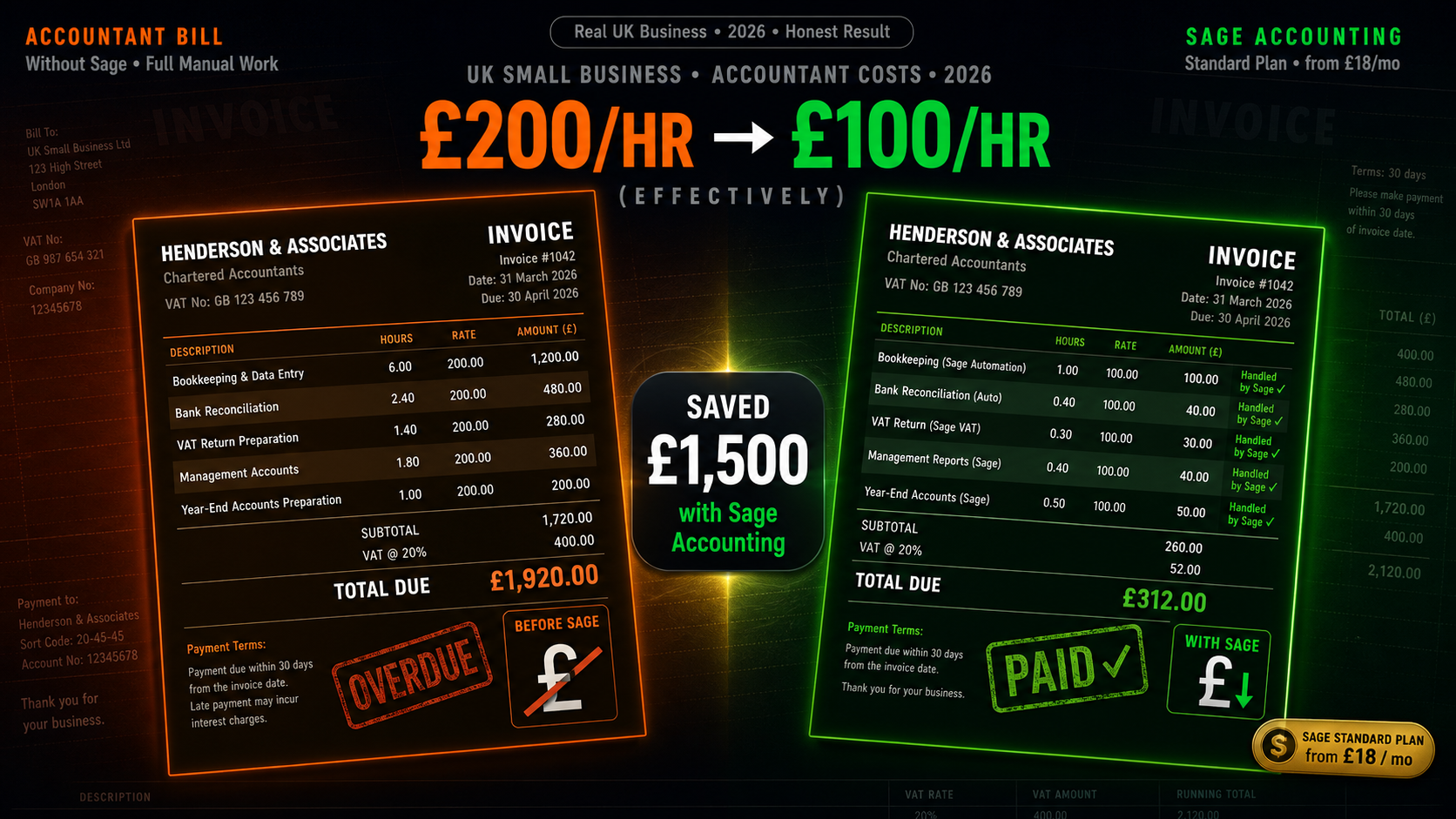
Nobody hires an accountant hoping to spend more money than necessary. But for most UK small business owners, the accountant’s bill arrives each month as a figure that feels too high, stays too high, and never obviously goes down — even when the business is not especially complicated and nothing particularly unusual has happened. That feeling is not paranoia. It reflects a real dynamic in how accountancy fees are generated, and understanding it is the first step to doing something about it.
The core issue is straightforward: accountants charge for time. And a significant proportion of the time most UK accountants spend on small business clients is not spent on expert judgement, tax strategy, or financial advice. It is spent on data gathering, bookkeeping correction, bank reconciliation, and chasing clients for information they should have been able to provide instantly. That work is expensive because qualified professionals are doing it. It is also largely avoidable — because the right accounting software, maintained properly, eliminates most of it before the accountant ever gets involved. This article explains exactly how that works, what the typical savings look like, and why Sage is the platform that makes the difference most consistently for UK small businesses.
What UK Accountants Actually Charge
UK accountant rates vary by region, firm size, and the complexity of the work — but the data for 2025 and 2026 is consistent enough to give clear benchmarks. General accounting services for small businesses run at £50 to £150 per hour across most of the UK. In London, that range extends to £75 to £300 per hour, with specialist tax and advisory work at the upper end. For a small limited company on a fixed monthly package, expect to pay £200 to £500 per month for a standard service covering accounts, corporation tax, payroll, VAT, and director’s self-assessment.
The self-assessment return alone typically costs £150 to £600 depending on the complexity of income sources. A year-end accounts preparation and corporation tax return for a small limited company generally runs £800 to £3,600 per year. VAT return preparation, if handled by the accountant rather than the business owner, adds further to the total. None of these figures are unreasonable for the work involved. The question is how much of that work was created by the way the business managed its records during the year — and how much of it was genuinely necessary.
Service | Typical UK Cost | London Range | Primary Driver of Cost |
|---|---|---|---|
General accounting (hourly) | £50–£150/hr | £75–£300/hr | Hours spent on data correction, reconciliation, chasing records |
Small limited company monthly package | £200–£500/mo | £300–£600/mo | Volume of transactions, state of records provided, software used |
Self-assessment tax return | £150–£600 | £250–£800+ | Number of income sources, completeness of records provided |
Year-end accounts & corporation tax | £800–£3,600/yr | £1,500–£5,000/yr | Months of uncategorised transactions, missing receipts, reconciliation backlogs |
Bookkeeping cleanup (per year behind) | £1,500–£8,000+ | £3,000–£15,000+ | Duration of backlog, transaction volume, complexity of corrections needed |
VAT return (accountant-prepared) | £100–£300/quarter | £150–£500/quarter | Whether digital records are MTD-compliant or require manual extraction |
Where the time actually goes
For a small business with 6–12 months of inconsistent bookkeeping, a cleanup alone takes 2–4 weeks of professional time. At £75–£150 per hour, that is a £3,000–£12,000 bill for work that your software should have prevented by keeping records correct throughout the year.
What Your Accountant’s Time Is Actually Spent On
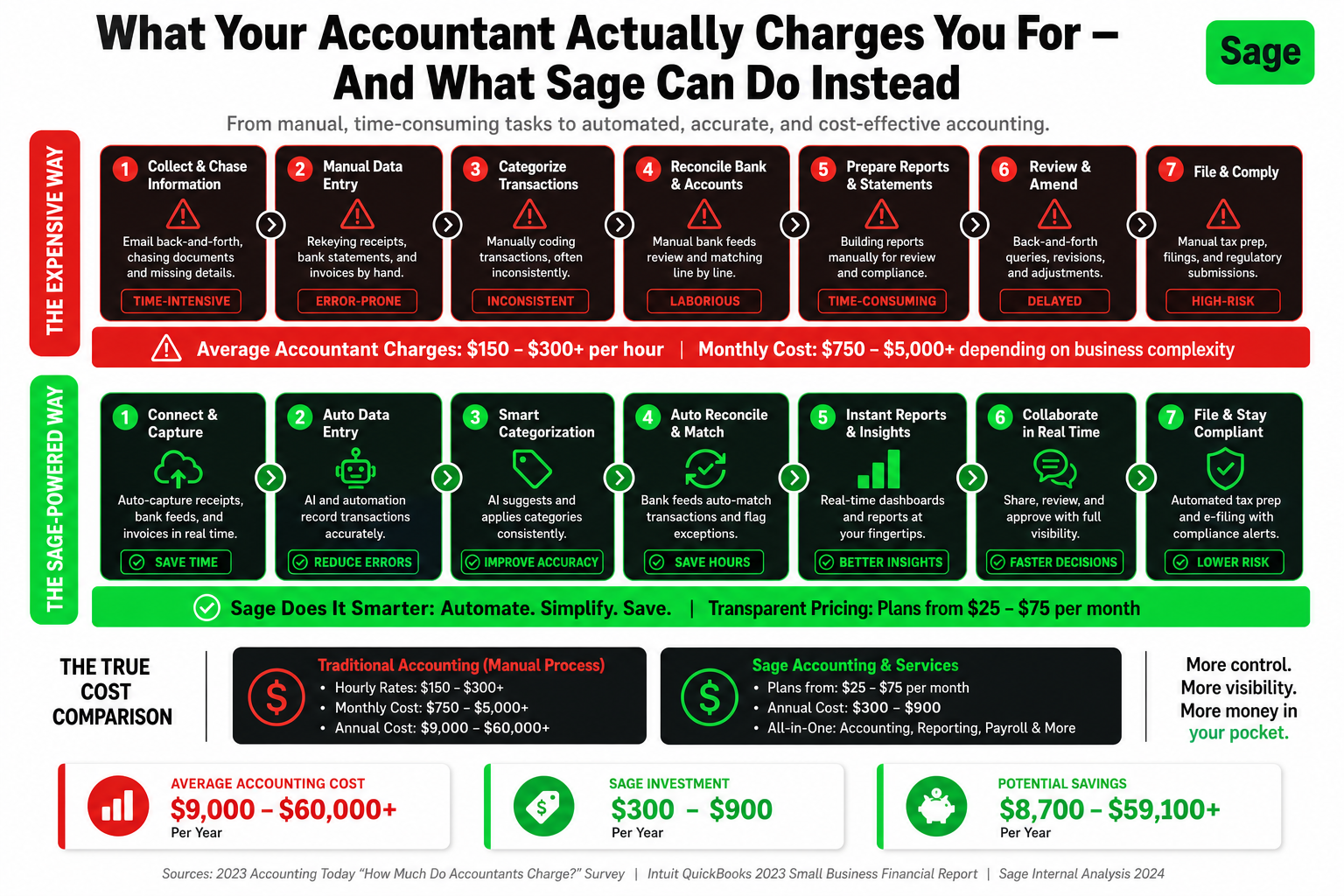
The uncomfortable truth about accountancy fees is that a large proportion of them are not paying for expertise. They are paying for remediation — fixing the gap between the records you provided and the records your accountant needs to do the work properly. That gap is created during the year, transaction by transaction, every time an expense goes uncategorised, a bank statement goes unreconciled, a receipt goes unfiled, or a VAT return is prepared from a spreadsheet that does not match the actual accounting records.
According to research from LinkedIn accounting practitioners, 80% of UK small businesses waste 12 or more hours per month on bookkeeping — that is one and a half full working days every month lost to receipts, spreadsheets, and manual reconciliation. When those businesses then hand their records to an accountant, the accountant faces the downstream consequences of that disorganisation: uncategorised transactions to investigate, bank balances that do not reconcile, missing documents, duplicate entries, and VAT records that require reconstruction before any return can be filed. Every hour your accountant spends on that work is an hour billed to you at professional rates for tasks that software performs automatically.
The pattern is consistent across accounting firms. Bookkeeping correction and data cleanup are among the most time-consuming parts of small business accounts preparation, and they are among the most completely avoidable. A business that arrives at year-end with clean, reconciled, categorised records in Sage reduces its accountant’s preparation time by the exact hours that would otherwise have been spent creating those records after the fact. That reduction translates directly into a lower bill.
The Six Tasks Sage Does So Your Accountant Does Not Have To
The time savings from proper accounting software are not vague or approximate. They come from specific tasks that, in a manual or disorganised bookkeeping workflow, fall to the accountant at preparation time. In a business using Sage properly throughout the year, those tasks are either automated or completed in real time, leaving the accountant with clean data rather than a correction project.
Bank reconciliation — Sage connects directly to UK bank accounts via open banking, importing transactions automatically and matching them to invoices and bills in the system. A business using Sage’s bank feeds reconciles in minutes per week rather than spending hours at month-end or handing the job to an accountant at year-end. Unreconciled bank statements are one of the most common drivers of additional accountant time on small business files.
Transaction categorisation — Sage learns from your previous categorisations and auto-suggests the correct category for recurring transactions. Sage Copilot extends this with AI-driven categorisation that handles the majority of routine transactions without manual intervention. Uncategorised or miscategorised transactions are a direct cause of accountant query time and potential tax errors.
Receipt capture and matching — the Sage mobile app allows receipts to be photographed and attached to transactions immediately. AutoEntry, integrated with Sage, extracts data from receipts and invoices automatically. The result is a complete audit trail with supporting documentation for every transaction — without a year-end receipt hunt.
VAT return preparation — Sage calculates VAT on every transaction in real time and generates the MTD-compliant VAT return automatically at the end of each quarter. The business owner reviews and submits directly from Sage without accountant involvement. At £100 to £300 per VAT return if prepared by an accountant, four quarters per year, the saving from self-submission through Sage is £400 to £1,200 annually before any other efficiency is considered.
Real-time reporting — Sage generates P&L, balance sheet, cash flow, and aged debtor reports from live data at any point in the year. When an accountant asks for management accounts, the business can share them instantly from Sage rather than requiring the accountant to prepare them from raw data. Management accounts prepared by an accountant on a quarterly basis typically cost £200 to £600 per set. Eliminating that cost across four quarters saves £800 to £2,400 per year.
Accountant collaboration access — Sage allows accountants to access the business’s records directly in real time, with full visibility into the current state of the books. The accountant does not need to request data exports, wait for files, or reconcile between what they received and what is in the system. That single feature typically reduces the time accountants spend on data handling for Sage clients by 30 to 50% compared with clients using spreadsheets or disconnected systems.
Sage Copilot: The AI Layer That Changes the Maths
Sage Copilot, the AI assistant built into Sage’s accounting platform, represents the most significant recent development in the time-saving argument. It is not a chatbot bolted onto existing software. It is an integrated AI layer that operates across the accounting workflow — categorising transactions, flagging anomalies, identifying duplicate entries, surfacing overdue invoices, and generating reports — without requiring the business owner to initiate each action manually.
The headline figure, cited directly from a Sage customer testimonial published in April 2026, is striking: “Sage Copilot saves us 12–14 hours on average every week.” That is not a claimed product benefit from a marketing brochure. It is a direct quote from a business using Copilot in their daily accounting workflow. At even the lowest UK accountant hourly rate of £50, 12 hours per week represents £600 of professional time per week, or over £30,000 per year. Even applying a fraction of that to reduced accountant fees rather than internal staff time, the financial case for Copilot is not subtle.
For the small business owner managing their own books, Copilot’s practical impact is in the reduction of the error rate that drives accountant correction time. Fewer miscategorised transactions means fewer accountant queries. Fewer duplicate entries means less reconciliation work. Automatic anomaly detection means problems are caught when they are easy to fix rather than at year-end when they have accumulated into a cleanup project. Sage also estimates that better adoption of accounting technology could cut business admin burden in half — and their own research found that reclaiming just one hour per week of SMB productivity across the UK would add £6.6 billion to the economy annually.
Before and After Sage: What the Accountant Sees
Without Sage (what your accountant receives)
Bank statements with no transaction categorisation — accountant must categorise or query every entry
Spreadsheet of income and expenses that does not reconcile with bank statements
Box of receipts, some digital, some paper, many unmatched to any transaction
VAT records manually extracted from a spreadsheet — does not constitute a valid MTD digital link
No management accounts during the year — first financial picture at year-end
Payroll records in a separate system or spreadsheet — journals must be manually posted
12 months of unreconciled bank transactions requiring investigation before accounts can be started
With Sage (what your accountant receives)
Fully reconciled, categorised transaction ledger with bank feed matched to the day of handover
Complete audit trail with receipts attached to every expense transaction
MTD-compliant VAT records submitted directly from Sage throughout the year — no accountant involvement required
Live P&L, balance sheet, and cash flow reports available in Sage at any point — no preparation needed
Direct read access to all records in real time — no data requests, exports, or transfers
Payroll journals automatically posted to the accounts after every payroll run
Sage Copilot flagging and resolving anomalies throughout the year — year-end is a review, not a rescue
The Real Numbers: What Moving to Sage Saves
The savings from moving to Sage are not theoretical — they come from specific, identifiable reductions in accountant time across several distinct tasks. The following calculation is based on conservative estimates using mid-range UK accountant hourly rates and typical small business transaction volumes. The actual saving for any individual business will depend on the current state of their records, their accountant’s rate, and how consistently they use Sage throughout the year.
Task | Accountant time without Sage | Accountant time with Sage | Annual saving at £100/hr |
|---|---|---|---|
Bank reconciliation (year-end) | 8–20 hours | 1–2 hours (review only) | £700–£1,800 |
Transaction categorisation & queries | 6–15 hours | 1–3 hours | £500–£1,200 |
Receipt matching & audit trail | 3–8 hours | 0 hours (attached in Sage) | £300–£800 |
VAT return preparation (4 quarters) | 4–12 hours | 0 hours (submitted via Sage) | £400–£1,200 |
Management accounts (quarterly) | 8–20 hours | 0–2 hours (real-time in Sage) | £800–£2,000 |
Data requests, exports & transfers | 3–6 hours | 0 hours (direct Sage access) | £300–£600 |
Total annual saving | — | — | £3,000–£7,600 |
Against a Sage Standard subscription of £39 per month (£468 per year), the return on investment at the conservative end of that saving range is over 6:1. At the mid-range, a business saving £5,000 per year in accountant fees is generating a 10:1 return on its Sage subscription cost. The saving does not require an especially complicated business, an especially inefficient accountant, or an especially bad set of starting records. It requires only that the business uses Sage consistently throughout the year rather than treating bookkeeping as a year-end task.
What Your Accountant Should Be Charging You For
The goal is not to eliminate your accountant. It is to redirect their time and your money towards the parts of the relationship that genuinely require expertise. A good accountant’s value is not in data entry, bank reconciliation, or VAT calculation. It is in tax planning, in identifying reliefs and allowances you would otherwise miss, in advising on business structure, in reviewing your financial position and flagging risks, and in managing HMRC correspondence when problems arise. Those are things Sage cannot do. They are also things that are very difficult to access when your accountant is spending the majority of their time on your files sorting out records that should have been sorted throughout the year.
When your records arrive clean and current, the conversation with your accountant changes. Instead of starting with “I need to work through your transactions before I can tell you anything,” it starts with “your position is X, and here are three things we should consider before year-end.” That second conversation is what most small business owners think they are paying for. Sage is what makes it available.
The accountants who work most effectively with Sage clients consistently report the same dynamic: the preparation time reduces significantly, the quality of the information available for planning improves, and the conversation moves from historical correction to forward-looking advice. For the business owner, that means getting more value from every hour of accountant time — which is the point of having one in the first place.
The Bottom Line
UK accountants charge between £50 and £300 per hour, and a meaningful proportion of that time is spent on work that your accounting software should have handled automatically throughout the year. Bank reconciliation, transaction categorisation, receipt matching, VAT return preparation, and management account production are all tasks that Sage either automates entirely or makes fast enough that they no longer create significant professional fee exposure at year-end.
The conservative estimate for annual accountant fee savings from moving to Sage and using it consistently is £3,000 to £7,600 per year for a typical UK small limited company. Against a Sage Standard subscription of £39 per month, that represents a return on investment of between 6:1 and 16:1. Sage Copilot, which real users report saving 12 to 14 hours per week, adds a further layer of automation that reduces the internal admin burden that creates accountant work downstream.
The business case for Sage is not really about software features. It is about what happens at the end of every month and every year when your accountant opens your file. Clean records in Sage mean a shorter preparation time, a lower bill, and a conversation about your business’s financial future rather than its administrative past. That is the difference between an accountant who costs £200 an hour and an accountant who delivers £200 an hour of genuine value — and it starts with what you give them to work with.