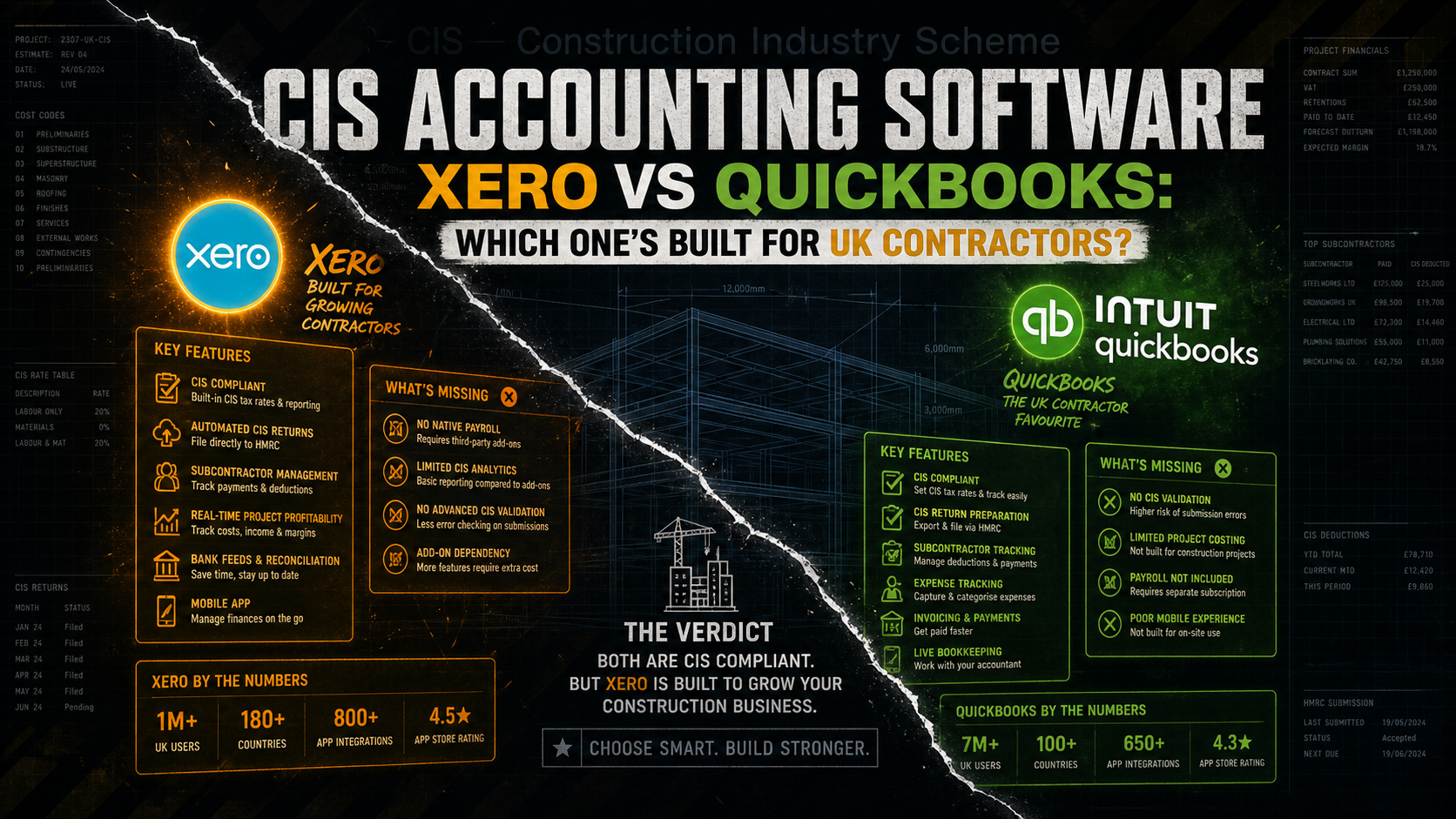
UK construction is in a persistent financial crisis that the industry has been living inside for long enough that it now barely makes the news. Construction has been the most insolvent sector in England and Wales for four consecutive years. In 2025, 3,931 construction firms became insolvent — representing 17% of all UK business failures, a share that the sector has held consistently since 2021. In February 2026 alone, construction accounted for 16.9% of all registered company insolvencies. Forecasts for 2026 suggest up to 43,000 construction companies could fold before the year is out.
The causes of construction insolvency are familiar: tight margins, retentions culture, extended payment terms, material cost volatility, labour shortages, and a subcontracting model that distributes financial risk downward through supply chains in ways that are hard to manage and harder to predict. What is discussed far less is the role that accounting systems — or rather, the absence of the right ones — play in turning a pressured business into a failed one. Construction has accounting obligations that do not apply to almost any other UK sector. Most generic small-business software does not handle them. And the gap between what those obligations require and what most construction businesses have in place is quietly making an already difficult situation worse.
Why Construction Accounting Is Fundamentally Different
A retail business records sales, matches expenses, files VAT, and does payroll. So does a marketing consultancy. The accounting logic is similar enough that software built for one serves the other adequately. Construction does not work that way. The Construction Industry Scheme, the domestic VAT reverse charge, project-level cost tracking, retention accounting, subcontractor verification, and monthly CIS returns are all features of construction accounting that have no equivalent in most other industries — and that generic accounting software either handles poorly, handles as an expensive add-on, or does not handle at all.
The consequence of that mismatch is not abstract. A contractor using software that does not natively support CIS must calculate deductions manually, verify subcontractors outside the system, and reconcile the results back into accounts that were not designed to accommodate them. A subcontractor using software that does not handle the domestic reverse charge correctly risks issuing invoices with the wrong VAT treatment — which can trigger HMRC investigations, penalty exposure, and cash flow problems that compound over multiple quarters before they are identified. The accounting software gap in construction is not a feature gap. It is a compliance gap. And in an industry where margins are already thin and insolvency rates are at historic highs, a compliance gap is a survival risk.
The Construction Industry Scheme: What It Requires and Where Businesses Get It Wrong
The Construction Industry Scheme requires contractors to deduct tax at source from payments to subcontractors and pay those deductions directly to HMRC. The rate of deduction depends on the subcontractor’s registration status: 0% for subcontractors with Gross Payment Status, 20% for registered subcontractors, and 30% for unregistered subcontractors. The difference between 20% and 30% on a £10,000 labour invoice is £1,000 — not a rounding error for a subcontractor working on thin margins.
The calculation applies only to the labour element of each invoice, not materials. A £15,000 invoice comprising £6,000 of materials and £9,000 of labour attracts CIS deduction only on the £9,000. Applying the deduction to the full invoice amount is a common error that overpays HMRC and underpays the subcontractor. The reverse — failing to apply the deduction at all — leaves the contractor liable for the unpaid tax and a penalty. Neither error is trivial. Both are common in businesses managing CIS manually or through software that does not separate labour and materials automatically.
The verification step most businesses skip
Before paying any subcontractor, contractors must verify their CIS registration status directly with HMRC and record the verification number. Applying the 20% rate to an unregistered subcontractor because you assumed they were registered exposes the contractor to the full 30% liability plus interest. Verification cannot be assumed or estimated — it must be confirmed with HMRC before each new subcontractor relationship begins.
Subcontractor Status | Deduction Rate | Applied To | Example: £10,000 invoice (£4,000 materials, £6,000 labour) |
|---|---|---|---|
Gross Payment Status | 0% | Labour element only | Full £10,000 paid; subcontractor handles own tax |
Registered subcontractor | 20% | Labour element only | £1,200 deducted (20% of £6,000); £8,800 paid to subcontractor |
Unregistered subcontractor | 30% | Labour element only | £1,800 deducted (30% of £6,000); £8,200 paid to subcontractor |
Wrong rate applied by contractor | Liability to HMRC | Contractor is liable for shortfall | Using 20% when 30% applies: contractor owes HMRC £600 plus interest and penalties |
The April 2026 CIS Changes That Raised the Stakes Further
From 6 April 2026, the Finance Act 2026 introduced new HMRC powers that fundamentally changed the risk profile of CIS non-compliance. The changes were introduced quietly but their implications are significant for any contractor operating with more than a handful of subcontractors. Under the new rules, HMRC can now hold a contractor liable for unpaid CIS tax and impose penalties if the contractor knew or should have known that a connected party in the supply chain had deliberately failed to comply with CIS obligations — even if the contractor themselves filed and paid correctly.
The phrase “should have known” is an objective test — HMRC will assess whether a reasonable business person in the same position ought to have identified the risk. That means due diligence is no longer optional. Contractors must now actively verify the compliance history, payment practices, and registration status of subcontractors before making payments. Records of those checks must be maintained. The connected party definition extends across the supply chain — not just direct subcontractors but any party involved in the same construction operations. A contractor who paid a subcontractor without adequate due diligence can now be held liable for that subcontractor’s fraud, regardless of whether the contractor themselves committed any error.
The penalties under the new rules are severe: HMRC can require the contractor to account for income tax on the relevant payment at 20%, impose an additional penalty of up to 30% of that tax assessment, and — critically — cancel the contractor’s Gross Payment Status and block reapplication for five years rather than the previous one year. For a contractor whose cash flow depends on receiving payments gross, losing GPS for five years is a business-altering event. For a business already operating on thin margins, the combination of a tax liability transfer and a 30% penalty is potentially terminal.
The Domestic VAT Reverse Charge: Three Years In, Still Causing Problems
The domestic VAT reverse charge for construction services has been in place since March 2021. Five years later, it remains one of the most frequently misapplied VAT rules in the UK. The reverse charge requires that for most construction services supplied between VAT-registered businesses in the supply chain, the customer accounts for the VAT rather than the supplier. Instead of the subcontractor charging VAT, collecting it, and paying it to HMRC, the contractor self-accounts for VAT as both input and output on the same return. The subcontractor’s invoice shows no VAT charged, and the contractor’s VAT return reflects both sides of the transaction simultaneously.
The practical impact on cash flow was significant when the rule was introduced and remains so. Before reverse charge, subcontractors collected 20% VAT on their invoices and held it until the next VAT return — effectively using it as working capital for up to three months. After reverse charge, that float disappears. A subcontractor invoicing £50,000 per month in construction services no longer receives £10,000 per month in VAT that sits in their account between quarters. That £10,000 per quarter — £40,000 per year — of working capital that previously cushioned cash flow is simply gone.
Scenario | Who Applies? | VAT on Invoice | Common Error |
|---|---|---|---|
Sub-contractor to VAT-registered contractor (not end user) | Domestic reverse charge | Zero — invoice states “reverse charge applies” | Subcontractor charges VAT as normal; contractor pays it; double accounting or cash flow loss |
Contractor to end user (building owner, developer) | Standard VAT | 20% VAT charged normally | Contractor applies reverse charge to end-user invoice incorrectly; end user refuses to pay VAT; HMRC investigates |
Contractor to connected company (same group) | Excluded from reverse charge | Standard VAT applies | Group company applies reverse charge incorrectly on intra-group construction services |
Zero-rated construction (new residential build) | Outside reverse charge scope | Zero-rated, not reverse charge | Zero-rating and reverse charge confused; different treatment, different reporting obligations |
Mixed supply: construction + professional services | Split treatment required | Reverse charge on construction; standard VAT on professional element | Entire invoice treated as reverse charge or entire invoice treated as standard VAT; both create errors |
The end-user declaration adds another layer of risk. A supplier can apply standard VAT rather than reverse charge where the customer has confirmed in writing that they are an end user. If that confirmation is given incorrectly, or if the customer’s status changes and the declaration is not updated, the subcontractor bears the compliance exposure for applying the wrong treatment based on incorrect customer information. Managing those declarations without a system that tracks end-user status per customer, per contract, and per invoice is a manual overhead that creates errors even in well-run businesses.
The Monthly CIS Return: Where Most Businesses Are Losing Time
Every contractor registered under CIS must submit a monthly return to HMRC showing the payments made to each subcontractor and the deductions applied. From April 2026, nil returns are reintroduced — contractors who made no CIS payments in a given month must file a nil return, or notify HMRC in advance that no payments will be made. The requirement was removed in 2015 and its reintroduction has caught many businesses off guard. Missing a nil return is now a compliance failure, and the late filing penalty applies regardless of whether any tax was actually owed.
The manual process for preparing a monthly CIS return is time-consuming in ways that compound with business size. Each subcontractor’s verification number must be recorded. The labour element must be separated from materials on each invoice. The deduction rate must be confirmed against the verified status. The net payment must be reconciled against the bank. The return must be submitted to HMRC by the 19th of the following month. For a contractor working with 20 or 30 subcontractors across multiple sites, the monthly CIS return is a significant admin burden that requires either dedicated staff time or reliable software automation — or both.
The cost of getting it wrong is asymmetric. Late or incorrect CIS returns attract penalties. An incorrect deduction rate — too low or too high — creates either a liability to HMRC or a dispute with the subcontractor. A missed verification creates a liability at the higher 30% rate regardless of the subcontractor’s actual status. Under the April 2026 changes, a subcontractor who turns out to have been involved in supply chain fraud can transfer a portion of that liability back to the contractor who failed to conduct adequate due diligence. In each case, the risk originates not in the complexity of the work the business does, but in the inadequacy of the administrative systems supporting it.
What Generic Software Does Not Do
The accounting software most commonly used by UK small businesses — tools designed primarily for retail, services, and professional practices — share a common weakness in construction contexts: they treat CIS as an edge case rather than a core workflow. The result is typically a system where VAT is handled in a standard way that does not accommodate reverse charge without manual workarounds, CIS deductions must be calculated outside the software and entered as manual journal adjustments, subcontractor verification is managed in a separate spreadsheet or not at all, and the monthly CIS return must be compiled from records that the software was not designed to produce.
Each of those workarounds introduces the same type of risk: a manual step where an error can enter the record without detection, where the connection between the source transaction and the final return is broken, and where the audit trail required to demonstrate compliance to HMRC does not exist in a form the software can generate automatically. The businesses most at risk are not those that are failing at the complex end of construction accounting. They are those that have built a workable-but-fragile system out of a generic accounting platform, supplementary spreadsheets, and manual reconciliation steps that work until they do not — which is usually when the business is under the most pressure.
What Construction-Specific Software Actually Provides
Sage Accounting for Construction is built around the three compliance obligations that define construction accounting in the UK: CIS, MTD for VAT with domestic reverse charge, and Making Tax Digital for Income Tax. These are not modules or upgrades. They are native features of the platform, designed to handle the specific workflows that construction businesses run every day without requiring manual calculation, separate verification processes, or workarounds that introduce compliance risk.
Generic accounting software
VAT applied as standard 20% to all eligible transactions — domestic reverse charge requires manual override on every qualifying invoice
CIS deductions calculated outside the system and posted as manual journal entries
Subcontractor verification managed in a separate spreadsheet; no connection to payment processing
Monthly CIS returns compiled manually from payment records; submitted separately from the accounting system
Labour and materials separation done manually on each invoice before deduction calculation
No nil return reminders; April 2026 requirement creates new missed-deadline exposure
Due diligence records for new CIS anti-fraud requirements maintained outside the system
End-user declarations tracked separately; no automated treatment based on customer status
Sage Accounting for Construction
Domestic reverse charge applied automatically based on customer VAT status and contract type — no manual override required per invoice
CIS deductions calculated automatically, separating labour and materials on each transaction
Subcontractor verification run directly within Sage against HMRC; verification number and deduction rate stored per subcontractor
Monthly CIS returns generated from transaction data and submitted to HMRC directly; nil returns managed automatically
UTR numbers, deduction rates, and verification records stored per subcontractor in the same system used for payment processing
Full MTD compliance built in; VAT return submitted directly to HMRC via the MTD API with a complete digital link
Payment and deduction statements generated automatically for each subcontractor after every CIS payment
Audit trail for all CIS and VAT transactions maintained automatically and accessible for HMRC inspection
The Cash Flow Impact of Getting CIS Right
For subcontractors, the cash flow benefit of managing CIS correctly is direct and material. The difference between receiving payments at a 30% deduction rate and receiving them at 20% is significant enough to affect whether a business can meet its own monthly obligations. A subcontractor with monthly labour income of £20,000 who is incorrectly treated as unregistered receives £14,000 net rather than £16,000 net — a £2,000 per month cash flow reduction that accumulates to £24,000 over a year while the excess deduction sits with HMRC awaiting reclaim.
For contractors, the cash flow impact runs in the other direction. Holding back the correct deduction from subcontractor payments means holding back exactly what HMRC is owed — no more, no less. Contractors who apply the wrong rate in either direction face either a liability to HMRC (if the rate was too low) or a dispute with the subcontractor (if the rate was too high). Either outcome requires resolution time, creates accounting complexity, and in the first case creates a direct cash cost. Gross Payment Status is the most valuable CIS outcome for a subcontractor because it means receiving payments in full with no deduction — but GPS requires a clean compliance record, which requires accurate records, which requires the right software from the outset.
The GPS compliance test
To qualify for and retain Gross Payment Status, a subcontractor must file all tax returns on time, pay all tax on time, have a minimum annual turnover of £30,000 (for sole traders) or £30,000 per director with a minimum of £100,000 (for limited companies), and maintain a clean compliance record with HMRC. Under the April 2026 changes, GPS can now be removed immediately and blocked for five years if a compliance failure is identified. A subcontractor whose bookkeeping system creates late returns or missed payments is putting GPS at risk — and with it, the cash flow advantage that GPS provides.
The April 2026 Due Diligence Requirement in Practice
The new “knew or should have known” standard introduced by the Finance Act 2026 creates a documentation obligation that most construction businesses have not yet operationalised. HMRC’s guidance makes clear that the test will be applied objectively: would a reasonable business person in the same position have identified the compliance risk? To satisfy that test, contractors need to be able to demonstrate that they conducted specific due diligence checks before making payments to each subcontractor, that they recorded the results of those checks, and that they acted on the findings.
Verification of CIS registration status — confirmed with HMRC before the first payment to each subcontractor and reviewed periodically; verification number recorded and stored against the subcontractor record
Review of compliance history — evidence that the subcontractor files returns and pays tax on time; particularly relevant where the subcontractor holds GPS, which can be revoked without notice
Assessment of unusual payment practices — HMRC’s guidance specifically references this as a risk indicator; requests for payment to third-party accounts, split payments, or cash payments outside normal commercial practice are red flags that must be investigated and documented
Employment status review — confirmation that the subcontractor relationship does not meet the IR35 employed-person tests, which would change the tax treatment entirely
Records of checks conducted — maintained and available for production if HMRC opens an enquiry; the absence of records is itself evidence against the contractor in a “should have known” assessment
Managing this process for a contractor with 15–30 active subcontractors requires a system. The subcontractor records in Sage — including UTR numbers, verification numbers, deduction rates, and payment history — provide the foundation for a due diligence trail that can be demonstrated to HMRC. Without that system, the contractor is dependent on memory, email trails, and manually maintained spreadsheets to prove that checks were conducted — and in an HMRC enquiry, the absence of contemporaneous records is a material disadvantage.
The State of the Industry in 2026
Metric | Figure | Source |
|---|---|---|
Construction firm insolvencies in 2025 | 3,931 | Insolvency Service / Irwin Mitchell, 2025 |
Construction share of all UK insolvencies | 17% (four consecutive years) | BCIS / Insolvency Service, Feb 2026 |
Construction insolvency rate per 10,000 firms | 52.6 (vs 42.6 pre-COVID) | Irwin Mitchell, August 2025 |
Forecast construction insolvencies in 2026 | Up to 43,000 | Liquidation Centre, March 2026 |
Construction insolvencies in December 2025 | 266 firms — highest December since records began | R3 / Insolvency Service, Jan 2026 |
Specialist subcontractors insolvent July 2025 alone | 195 firms — highest sub-sector figure | Irwin Mitchell, September 2025 |
New CIS fraud powers effective from | 6 April 2026 (Finance Act 2026) | HMRC / Trowers & Hamlins, 2026 |
GPS reapplication block under new rules | 5 years (previously 1 year) | Prevail Accountancy / Saffery, 2026 |
Maximum penalty for CIS fraud connection | 30% of tax assessed plus potential personal liability for directors | Finance Act 2026 / Trowers & Hamlins |
The Bottom Line
Construction is not like other industries, and construction accounting is not like other accounting. The Construction Industry Scheme, the domestic VAT reverse charge, monthly returns, subcontractor verification, GPS management, and now the April 2026 supply chain fraud due diligence requirements combine to create a compliance environment that is materially more complex, more frequently updated, and more exposed to personal liability than the accounting obligations facing almost any other type of UK small business. Generic accounting software was not designed for this environment. It accommodates it imperfectly, with workarounds that introduce the errors they are supposed to prevent.
The 3,931 construction firms that became insolvent in 2025 did not all fail because of accounting software. But for a sector trading on thin margins in a high-enforcement environment, the administrative burden of managing CIS, reverse charge, and now supply chain due diligence manually is a compounding cost that businesses with the right systems do not carry. Sage Accounting for Construction builds the compliance in at the transaction level: the reverse charge is applied automatically based on customer status, the CIS deduction is calculated from the verified subcontractor record, the monthly return is generated from the payment data, and the nil return obligation is managed without a separate reminder system. The compliance does not depend on the business owner remembering the rules. It depends on the system knowing them — which is exactly what “construction-specific” means in practice.
The gap between what construction businesses need from their accounting software and what most of them currently have is not a technology problem that requires a large investment to solve. Sage Accounting for Construction starts from the same price point as the generic software most construction businesses are already using. The difference is not cost. It is whether the software was built for construction or adapted to it after the fact — and in a sector where the compliance rules are specific, the penalties are personal, and the insolvency statistics are the worst of any UK industry, that distinction is not academic.