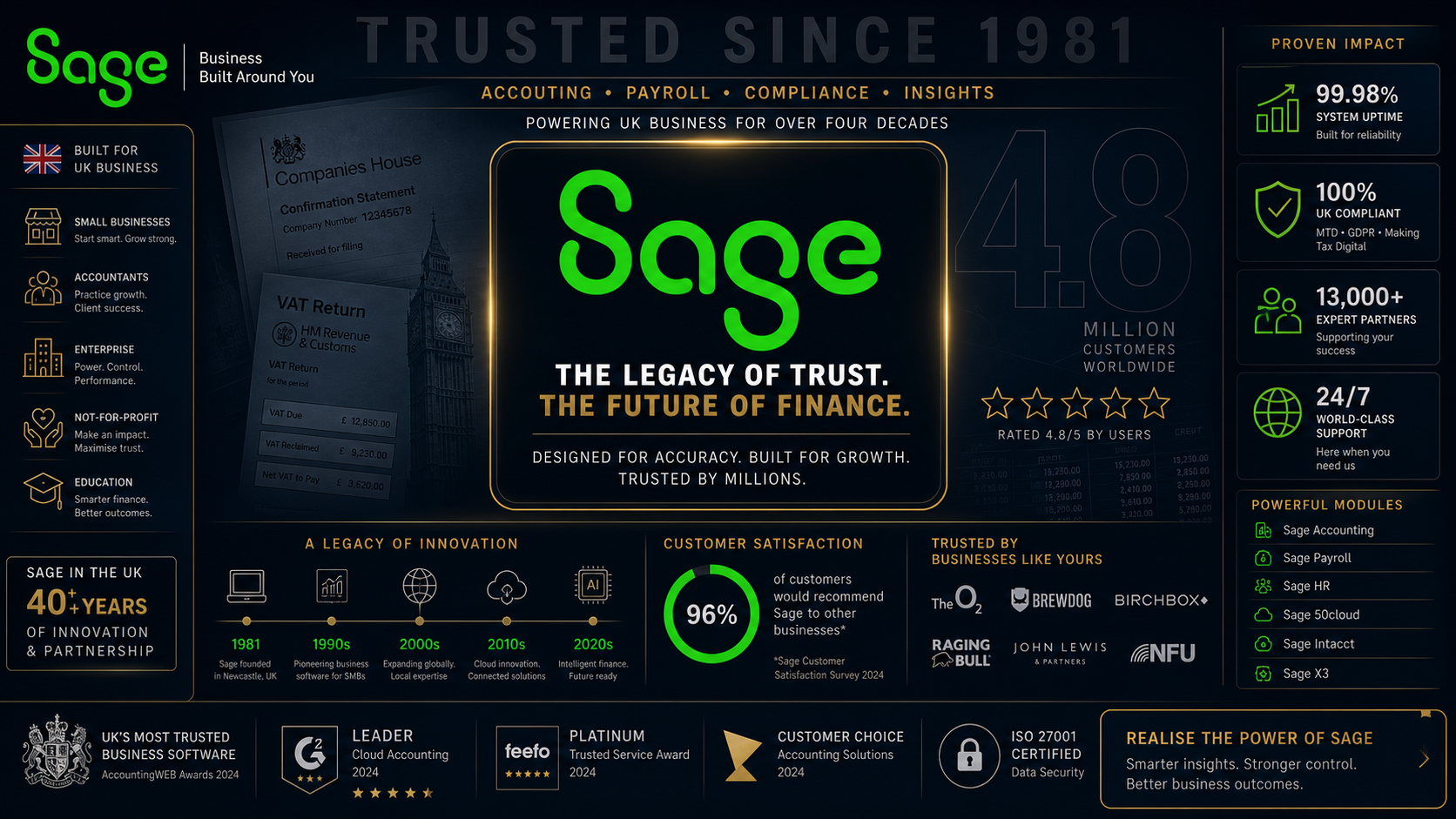
Trust in business software is not built quickly, and it is not built on marketing. It is built over years of a product doing what businesses need it to do, in the regulatory environment those businesses actually operate in, without catastrophic failure at the moments that matter most. By that measure, Sage’s position in the UK market is not a marketing achievement. It is the cumulative result of four decades of presence in the UK, consistent investment in the compliance obligations that UK businesses face, and a product evolution that has kept pace with changes — from desktop software in 1981 to cloud accounting in the 2010s to AI-powered automation in 2026 — that could have left an older platform behind.
The result is a market position that is genuinely unusual. Sage holds an estimated 40% of the UK SME accounting software market, serves more than 6.2 million businesses globally, and in January 2026 was named Britain’s Most Admired Software & IT Services Company at the London Stock Exchange — the UK’s longest-running and only peer-reviewed survey of corporate reputation. In February 2026, it was independently named Best Accounting Software UK 2026 by Consumer365’s assessment based on feature depth, automation capability, and SME suitability. This article explains what is behind those numbers and that recognition — and why the trust that UK small businesses place in Sage in 2026 is grounded in something more durable than brand familiarity.
45 Years of Building for the UK Market
Sage was founded in Newcastle-upon-Tyne in 1981 by David Goldman, Paul Muller, and Graham Wylie. The origin is worth understanding because it shapes everything that followed: Sage was not built as a generic financial tool that was later localised for the UK. It was built in the UK, for UK businesses, from day one. The initial product was designed to automate print estimating and basic accounting for a printing business in the north-east of England. Within its first year of commercial sales, monthly sales grew from 30 copies to over 300. By 1989, Sage was listed on the London Stock Exchange. By 1999, it entered the FTSE 100, where it remains.
That history matters for a specific reason: every UK-specific compliance obligation that Sage handles — PAYE, VAT, Corporation Tax, Self Assessment, CIS, Making Tax Digital — was not retrofitted to a platform built for another market. It was developed as a native feature of a platform that has been tracking UK tax law since the early 1980s. When HMRC introduced Making Tax Digital for VAT in 2019 and expanded it in 2022, Sage already had the architecture, the HMRC relationships, and the UK-specific data model to implement it correctly. When MTD for Income Tax launched in April 2026, Sage was ready before the legislation was finalised. That is not a coincidence. It is the advantage of four decades of building for exactly this market.
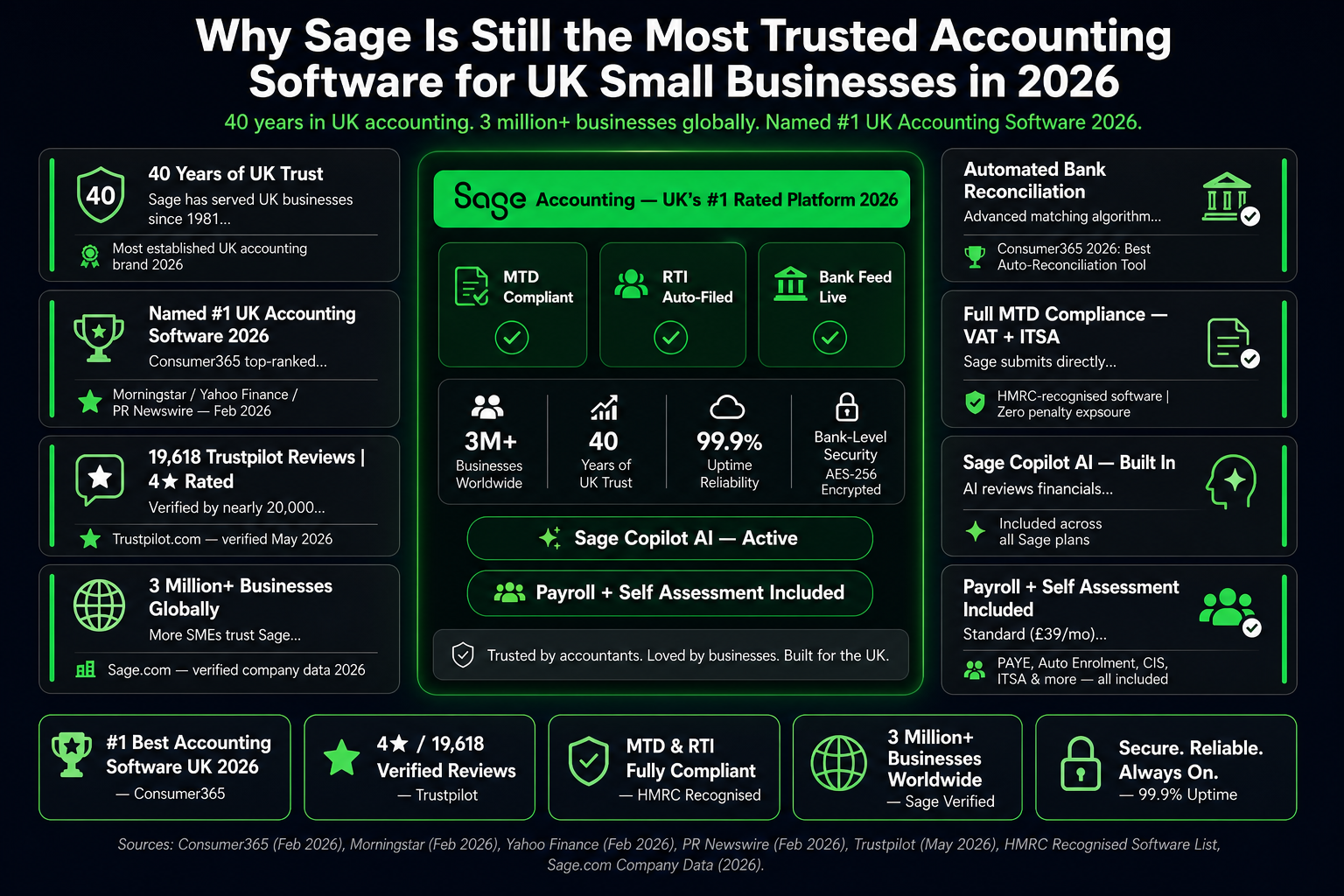
The FTSE 100 context
Sage is one of very few software companies in the FTSE 100 — the index of the UK’s 100 largest publicly listed companies by market capitalisation. That position means Sage operates under the financial scrutiny, governance standards, and long-term investment obligations of a major public company, while remaining a product built specifically for small and medium-sized businesses. The combination of institutional scale and SME focus is unusual and directly relevant to the reliability and longevity that trust requires.
The Financial Performance Behind the Trust
Trust in software vendors is partly a product of confidence that the company will still exist and still be investing in the product in three years. For a small business that builds its compliance workflows around an accounting platform, a vendor that fails, pivots, or cuts development is a serious operational problem. Sage’s financial performance in 2025 and into 2026 provides strong evidence of a company accelerating rather than declining.
Metric | FY2025 Result | Growth vs Prior Year | Significance |
|---|---|---|---|
Total underlying revenue | £2,513 million | +10% year-on-year | Consistent double-digit growth; revenue accelerating not plateauing |
Sage Business Cloud revenue | £2,083 million | +13% | Cloud platform (which includes UK SME accounting) is the dominant revenue driver |
Cloud native revenue | £885 million | +23% | Fastest-growing segment; modern cloud products gaining users at pace |
Underlying operating profit | £600 million | +17% | Profitability growing faster than revenue; sustainable investment capacity |
Operating margin | 23.9% | Up from prior year | Expanding margin funds ongoing R&D and product development |
UK & Ireland revenue (Q1 FY2026) | £194 million | +10% | UK remains a primary growth market; domestic investment continuing |
Total Q1 FY2026 revenue | £674 million | +10% organic growth | Strong start to FY2026; growth accelerating from Q4 FY2025 |
The cloud native revenue growth of 23% is the figure most relevant to UK small business users. It reflects the transition from legacy desktop products to the modern cloud accounting platform that includes Sage Accounting, Sage Payroll, and the full suite of tools used by small businesses. A 23% growth rate in the modern platform means Sage is adding new users faster than it is losing existing ones — the opposite of a product in decline. Combined with the overall 10% organic revenue growth confirmed for Q1 FY2026, the financial picture is of a company whose UK small business product is growing, not coasting.
What “Most Admired” Actually Means
Britain’s Most Admired Companies is not a self-nomination award or a customer survey. It is a peer-reviewed assessment conducted annually by Management Today, in which senior executives at major UK companies are asked to score their industry peers across nine criteria: quality of management, financial soundness, quality of goods and services, ability to attract and retain talent, investment value, innovation, community and environmental responsibility, use of corporate assets, and international competitiveness.
Sage was awarded the Gold award and topped the Software & IT Services league table for 2025, with the result announced at the London Stock Exchange in January 2026. The peer-review structure is significant: the recognition comes from other senior business leaders in the same sector assessing Sage’s performance across all nine dimensions, not from a marketing team’s submission to a shortlist. Being named Britain’s Most Admired Software & IT Services Company in that context is an assessment of strategic clarity, management quality, and product quality made by the people best positioned to evaluate them.
The Consumer365 Best Accounting Software UK 2026 recognition adds an independent product-level assessment to the peer-level recognition. The Consumer365 evaluation specifically highlighted Sage’s automation capability, bank reconciliation speed, error-minimising workflows, and MTD compliance as the factors underpinning its top placement. These are the same features that appear consistently in positive user reviews on Capterra, GetApp, and G2: the automation works, the compliance is built in, and the product does what UK small businesses actually need it to do.
The MTD Advantage No Competitor Can Replicate Quickly
Making Tax Digital is not a feature that can be added to accounting software in a development sprint. It requires a direct API connection to HMRC’s production systems, tested and certified across multiple tax obligations, maintained as HMRC updates its specifications, and built into the accounting workflows of the platform at a level that creates the unbroken digital link the rules require. Building and maintaining that infrastructure takes years of investment and an ongoing relationship with HMRC that smaller or newer competitors do not have at the same depth.
Sage has been HMRC-recognised since the earliest days of digital filing. Its MTD for VAT implementation was one of the first to go live in the pilot phase. Its MTD for Income Tax readiness was confirmed well in advance of the April 2026 mandatory start date, including the quarterly update workflow, the year-end final declaration process, and the digital record-keeping structure required by the rules. For a UK small business choosing accounting software in 2026, the question is not whether Sage is MTD-compliant. It is whether other options are as deeply integrated with HMRC’s systems, as proven across multiple tax obligations, and as consistently updated as HMRC’s requirements evolve. The answer, for most competitors, is not yet.
Sage Copilot: The 2026 Differentiator
Sage Copilot is the AI-powered productivity assistant built natively into Sage Accounting. It is not an external tool that connects to Sage via an API. It runs within the same environment as the accounting data, which means it has access to the full transaction history, the supplier and customer records, the VAT positions, the outstanding invoices, and the cash flow position — and it operates across all of them simultaneously rather than working with an exported subset of the data.
In February 2026, Sage announced the expansion of Copilot into agentic AI capabilities for invoicing and payment workflows. The key verified performance figure from Sage’s own published data: payments were received 7 days faster on average for businesses using Copilot’s automated invoice chasing, based on 21 customer test cases. That is not a projected benefit or a theoretical efficiency — it is a measured outcome from live UK business use. For a sole trader or small limited company for whom cash flow timing is the difference between a comfortable month and a stressful one, seven days faster payment across a full invoice book is a material improvement in the operating reality of the business.
Automated invoice chasing — Copilot identifies overdue invoices, drafts follow-up messages in the business owner’s own tone and timing, and sends them automatically; payments received 7 days faster on average in tested cases
Transaction categorisation — learns from previous categorisation decisions and auto-suggests the correct category for recurring transactions; reduces manual categorisation time by over 80% within three months for most users
Anomaly detection — flags unusual transactions, duplicate entries, and amounts that break established patterns; catches errors before they accumulate into year-end reconciliation problems
Cash flow alerts — proactively surfaces projected cash shortfalls before they occur, based on current balances, outstanding receivables, and known upcoming payments
Expense auto-capture — extracts line-item data from photographed receipts via the Sage mobile app; categorises and posts automatically with the receipt attached as a digital document
Personalised business advice — responds to natural language queries about the business’s financial position, outstanding obligations, and performance trends using live data from the accounting records
The Pricing That Makes the Trust Accessible
Market leadership and product quality are only part of the trust equation. A product that is trusted but unaffordable for the businesses that need it most is not fulfilling the purpose that trust implies. Sage’s 2026 pricing structure for small businesses is built around three tiers of Accounting and three tiers of Payroll, with clear incremental pricing that allows a business to start with the minimum it needs and upgrade as its requirements grow.
Plan | Monthly Price | Best For | Key Inclusions |
|---|---|---|---|
Accounting Start | £15/month | Sole traders, freelancers just starting out | Invoicing, bank feeds, MTD VAT, basic reporting, Sage Copilot |
Accounting Standard | £30/month | Growing small businesses | Everything in Start plus receipt capture via mobile, cash flow forecasting, more detailed reporting |
Accounting Plus | £39/month | Businesses with inventory or multi-currency needs | Everything in Standard plus inventory management, multi-currency, advanced features |
Payroll Essentials | From £8/month | Businesses with employees needing basic PAYE and payslips | PAYE, NIC, pension calculations, HMRC RTI submissions, payslips |
Payroll Standard | From £13/month | Businesses with more complex payroll needs | Essentials plus HR features, auto-enrolment management, employee self-service |
Payroll Premium | From £20/month | Businesses needing full HR and timesheet integration | Standard plus timesheets, overtime management, advanced HR workflows |
The Accounting Start plan at £15 per month is notable for what it includes at that price point: bank feeds, MTD-compliant VAT submission, invoicing, and access to Sage Copilot. For a sole trader or freelancer who needs nothing more than clean digital records, compliant VAT filing, and professional invoicing, the entire compliance requirement is met at the cost of approximately 50 pence per day. The higher-tier plans extend capability rather than introducing essential features as paid upgrades — which means businesses can be genuinely compliant and professionally equipped at the lowest tier, and choose to upgrade based on what they actually need rather than what is withheld to push them up the pricing ladder.
What the Market Position Actually Reflects
A 40% market share in UK SME accounting software is not maintained by inertia. The UK market has active competition from Xero, QuickBooks, FreeAgent, and a range of smaller platforms. Each has genuine strengths. Xero has strong third-party integrations. QuickBooks has a well-regarded mobile experience. FreeAgent has a clean interface that appeals to freelancers and contractors. Sage’s continued dominance in this competitive environment reflects something specific: the breadth and depth of its UK-specific compliance coverage, and the confidence that comes from forty-five years of UK market presence, cannot be matched by a platform that entered the UK market more recently or that treats UK compliance as one regional variation among many.
The peer-reviewed recognition as Britain’s Most Admired Software Company and the independent recognition as Best Accounting Software UK 2026 arrive in a year when the UK compliance environment has become more demanding, not less. MTD for Income Tax’s mandatory start, new CIS fraud powers, and an intensified HMRC enforcement posture on VAT have all raised the stakes for getting accounting right. In that environment, the most trusted accounting software is not the most feature-rich, the cheapest, or the most recently funded. It is the one that has the deepest compliance infrastructure, the longest track record of getting UK tax right, and the financial stability to keep investing in staying ahead of what HMRC requires next. In 2026, that description fits Sage more precisely than any of its competitors.
The Bottom Line
Sage’s position as the most trusted accounting software for UK small businesses in 2026 is built on five compounding advantages: 45 years of UK-specific product development that no competitor can replicate; 40% SME market share that reflects genuine user preference across a competitive field; £2,513 million in annual revenue growing at 10% with cloud native revenue growing at 23%, providing the investment capacity to stay ahead of compliance and technology changes; peer-reviewed recognition as Britain’s Most Admired Software Company announced at the London Stock Exchange; and Sage Copilot’s agentic AI capabilities that are already producing measurable outcomes — seven days faster payment collection — for UK small business users.
None of those advantages exists in isolation. The financial strength funds the product investment. The product investment produces the compliance depth. The compliance depth earns the market share. The market share generates the user data that makes Copilot’s AI more accurate than a platform with fewer users could achieve. And the peer recognition reflects all of it: not a single impressive feature, but a forty-five year accumulation of doing the right things for UK businesses in a market that has changed dramatically and will continue to change.
Trust, in accounting software, is ultimately about one thing: can I rely on this to keep me compliant, accurate, and financially visible, every month, without requiring heroic effort on my part? For 6.2 million businesses globally and an estimated 40% of the UK SME market, the answer to that question is Sage. In 2026, with the most demanding UK compliance environment in a decade and an AI layer that is already changing what accounting software can do, that answer is more current than it has ever been.