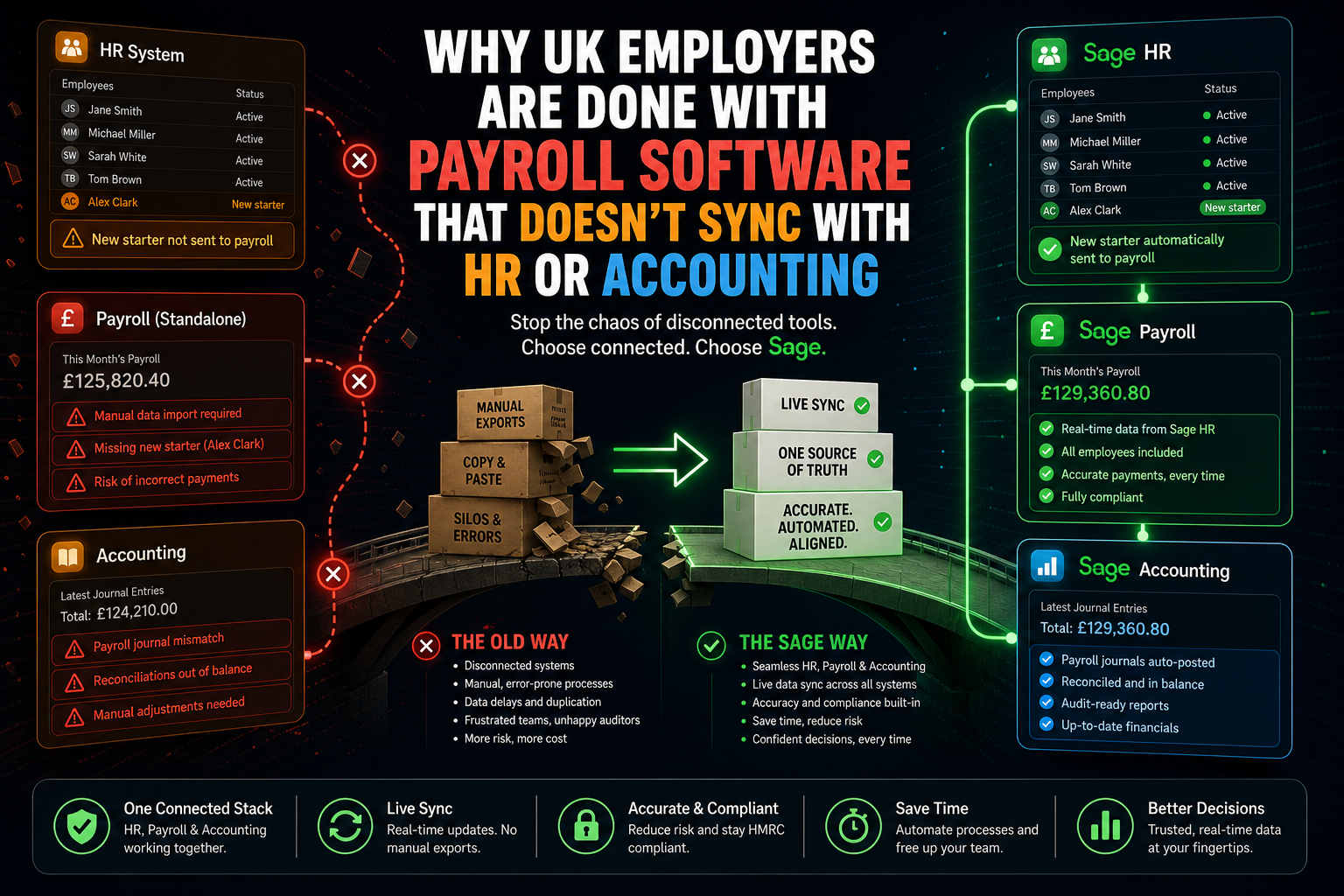
It used to be acceptable for HR, payroll and finance to live in three different systems. HR kept the people data, payroll ran the numbers, finance pulled in the totals, and everyone relied on spreadsheets, emails, and muscle memory to keep those three worlds loosely aligned. That model was fragile even when you had ten employees. At fifty or five hundred, it does not just creak. It snaps.
UK employers are increasingly saying the quiet part out loud: they are done with payroll software that does not talk to HR or accounting. HR vendors advertise “no more juggling systems and people data.” Payroll vendors promise “joined-up employee and pay data.” Sage has gone further still, launching an entire HCM platform whose sole purpose is to connect HR, payroll and finance data on one spine so that labour costs, payroll accuracy and workforce planning stop depending on manual reconciliations.
The Three Silos That Break Payroll
When employers complain that their payroll software is “broken,” they usually mean one of three things: it does not know what HR knows, it does not know what accounting knows, or nobody can see the whole picture at once.
HR and payroll don’t share a single employee record. Separate HR and payroll systems create duplicate records, incorrect employee data and long-winded payroll runs.
Payroll and accounts don’t share journals. Many businesses still export CSVs and re-key figures into their accounting software, with all the errors and delays that entails.
Time and attendance data lives in its own island. Hours and absence are approved in one tool, but payroll has to manually interpret and re-enter them every month.
Vendors across the market now call this out directly and position “single source of truth” and native integration with finance as the top criteria for choosing HR and payroll systems.
The Cost of Systems That Don’t Sync
The most visible cost of disconnected payroll software is time. HR teams type the same starter details into multiple systems. Payroll teams re-enter hours and pay changes. Finance teams rebuild payroll totals in the GL. But the less visible cost is far more serious: bad decisions based on incomplete or stale data.
Delayed or duplicated changes. Pay rises recorded in HR but not in payroll until the next run. Leavers processed in payroll but not in HR. People analytics showing outdated salaries while finance is forecasting from incorrect figures.
Manual reconciliations as a permanent job. Spreadsheets and pivot tables become the only way to see labour costs by department, project or entity because no system shows a joined-up view.
Compliance gaps you can’t see coming. With contracts, hours and pay held in different systems, checking minimum wage, holiday pay and overtime rules becomes a manual audit exercise instead of a system check.
The “export to Excel” red flag
The moment someone says “I’ll just export that from payroll and match it to HR or finance in Excel”, you know the systems are not really integrated. Every export is a point where data goes out of sync and decisions are made on a snapshot instead of live numbers.
What the Market Is Moving Towards
The direction of travel is easy to see from how HR and payroll vendors talk about themselves now.
Integrated HR and payroll products promise no more duplicate data entry, one employee record feeding both HR and payroll, and faster, cleaner payroll runs.
Modern payroll tools advertise automatic posting of journals into accounting platforms like Sage Accounting, Xero, QuickBooks and Netsuite, instead of CSV imports.
“Single source of truth” and “joined-up people and pay data” have become standard lines on the homepages of serious HR and payroll systems.
Employers have learned the hard way that a “good” stand‑alone payroll tool which cannot talk to HR or accounting is still a liability. The value now lies in how well it fits into the wider system, not just how nicely it runs a payslip.
Sage’s Answer: One Spine for HR, Payroll and Finance
Sage has been moving deliberately into this integrated space: Sage Payroll and Sage Accounting for small and growing UK businesses, and Sage HCM with Sage Intacct for mid‑market organisations that need deeper HR and finance capability.
Sage Payroll + Sage Accounting (UK)
Sage’s UK payroll packages are HMRC‑recognised, RTI‑ready and cloud‑based, designed to automate payroll calculations, submissions and auto‑enrolment while integrating with HR. Within the Sage ecosystem, payroll journals post directly into Sage Accounting, so finance can see payroll costs as soon as a run is completed instead of waiting for manual journals.
In practice, that means:
New starters and changes recorded once in HR flow through to payroll without re‑keying.
Each payroll run produces a mapped, balanced journal that can be posted straight into Sage Accounting.
RTI submissions to HMRC are generated from live payroll data and sent from within Sage rather than being re‑entered elsewhere.
Sage HCM + Sage Intacct (Mid‑Market)
For larger organisations, Sage HCM brings HR, payroll, time and talent management into a single cloud solution that connects natively to Sage Intacct financials. The goal is straightforward: close the data gaps between HR and finance so labour costs are visible, accurate and actionable.
HR, payroll and workforce data sit on the same platform, so there is one version of the truth about headcount, pay and roles.
Time entries, payroll runs and journals sync into Intacct in real time, giving finance live visibility of labour costs by entity, department or project.
Construction and project‑based variants link labour, payroll and job costing so project profitability reflects real, current labour spend, not last month’s spreadsheet.
Instead of HR, payroll and finance teams each working from their own set of reports and spreadsheets, they are all looking at the same underlying data, updated once and reused everywhere.
Disconnected vs Sage‑Connected: A Side‑by‑Side View
Scenario | With Disconnected Tools | With Sage Stack |
|---|---|---|
New starter joins | HR creates a record in one system, payroll re‑keys details, finance only sees the cost when the first manual journal is posted. | HR record in Sage HR / Sage HCM flows to payroll automatically; first payroll run posts a journal directly into Sage Accounting or Intacct. |
Mid‑year pay rise | HR updates the contract; payroll misses the change for one run; finance forecasts labour costs using old salary data. | Salary updated once in HR/HCM and synced to payroll and finance so payslips, journals and reports all reflect the new figure. |
Month‑end close | Payroll exports CSV → Excel adjustments → upload to accounts → reconciliation and error‑chasing. | Payroll journal generated and posted from Sage Payroll into Sage Accounting or Intacct; finance sees the final numbers immediately with a clear audit trail. |
Project labour cost | Hours in one system, payroll in another, job costing in a third; someone spends days matching them by hand. | Sage HCM and Intacct share time, payroll and job costing data so labour cost by project is visible without manual stitching. |
The Bottom Line
UK employers are not walking away from stand‑alone payroll software because they have suddenly become obsessed with integration as a buzzword. They are walking away because they can see, in real numbers, the cost of systems that do not sync with HR or accounting: duplicated work, repeated errors, slow month‑ends and blurry labour‑cost visibility.
Sage’s integrated approach is built for that reality. For smaller employers, Sage Payroll connected to Sage Accounting puts people data, pay runs and financials on a single, UK‑specific platform. For mid‑market organisations, Sage HCM with Sage Intacct becomes the backbone that connects HR, payroll and finance data end‑to‑end. The result is less time moving data between tools and more time actually running the business, with a live, accurate view of what your workforce is really costing you.