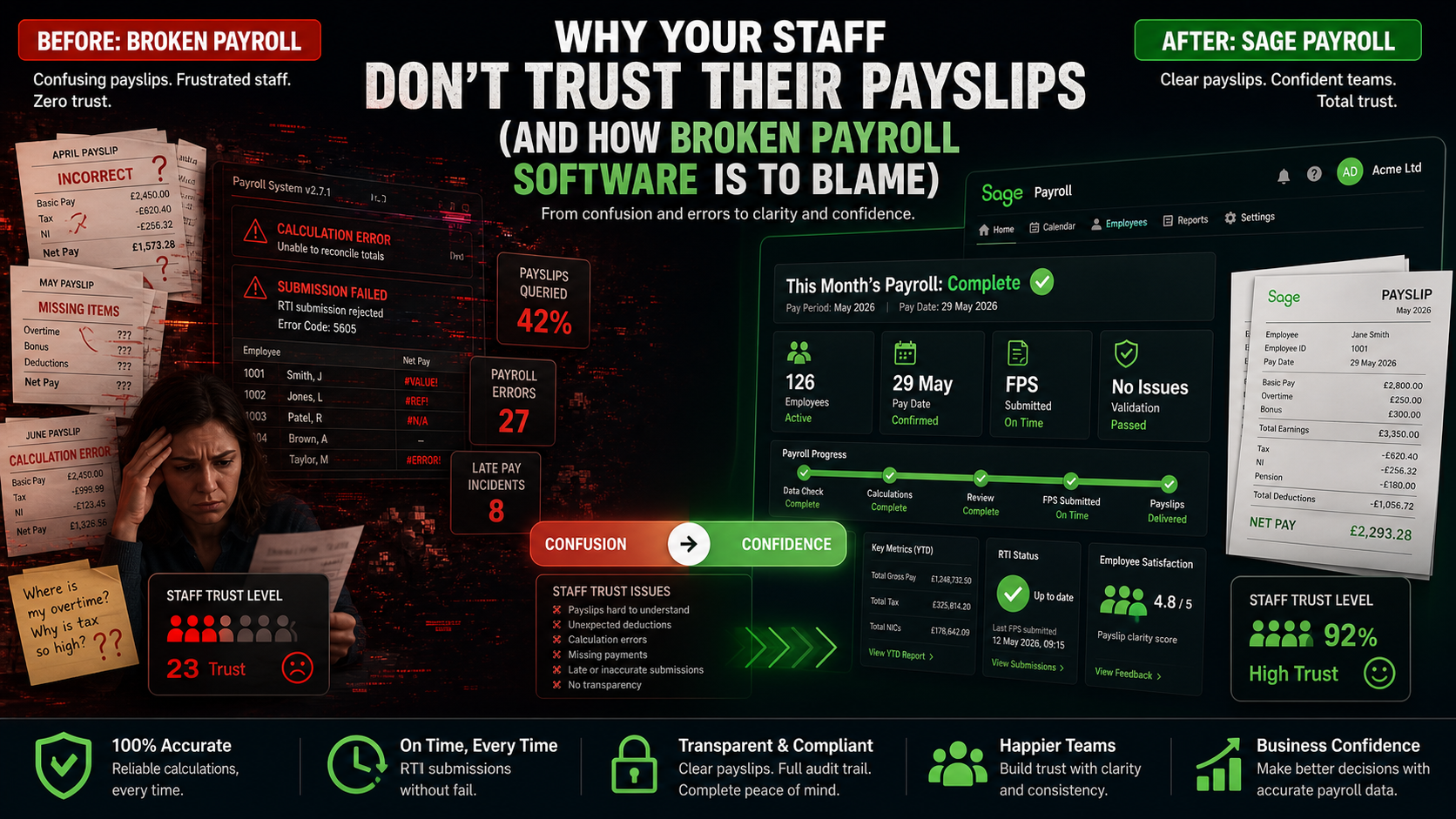
When your staff open their payslips and their first instinct is to double‑check the numbers, you do not have a “communication problem.” You have a trust problem. And in 2026, that trust problem is usually downstream of something far more specific than “people make mistakes.” It is downstream of brittle, outdated, or badly configured payroll systems trying to keep up with UK rules that change every year.
Payroll research in the UK paints a stark picture. One major survey by Zellis found that 60% of employees have spotted mistakes on their payslip, and 39% have been paid late at least once. Another study found that 43% of workers have experienced payslip errors, often overpaying tax as a result. [web:488] The Global Payroll Association reports that 88% of UK businesses experienced payroll errors in 2022 that left staff unpaid correctly or on time. Against that backdrop, staff scepticism is not paranoia. It is pattern recognition.
The Real Picture: How Common Payslip Problems Actually Are
Payroll is one of those functions that only gets noticed when it goes wrong. The data shows it goes wrong more often than most employers like to admit.
Zellis’s research found that one in five Brits (21%) has changed jobs after being paid late or inaccurately. On a national scale, that is nearly seven million people.
60% of employees in the same study had identified mistakes on their payslips.
A QuickBooks survey found that 43% of workers have previously experienced errors on their payslip, and that payroll complexity after Covid made checking payslips more important than ever.
The Global Payroll Association’s UK figures showed 88% of businesses reporting regular payroll errors in 2022, and half of respondents believed better payroll systems would improve the situation.
A SimplyBusiness study reported that 84% of small business owners make payroll errors, with 48% miscalculating wages and 40% having already received penalties.
The message is consistent: the average UK employee has enough direct experience of payroll errors to be cautious. The average UK employer underestimates how corrosive those errors are for trust. Staff do not need to understand every detail of a payslip to sense whether the system behind it is reliable.
Confusing Payslips + Broken Systems = Mistrust
Trust does not only break when numbers are wrong. It also breaks when numbers might be wrong and nobody feels able to tell. Zellis’s 2023 financial wellbeing research found that 28% of employees find their payslips difficult to understand because of acronyms and technical terms. 27% said they do not have the knowledge or confidence to know whether their payslip is correct or not. For younger UK staff aged 18–34, nearly a third said they do not fully understand how their tax is calculated, and a quarter said the same about pension deductions. [web:485]
At the same time, many employees barely check their payslips in detail. QuickBooks found that 31% of workers do not check because they simply trust their employer to get it right, while 16% do not understand their payslip and 10% are not even sure how to access it. [web:488] HBHR’s 2026 research shows almost half of employees skim‑read or rarely look at payslips at all, leaving errors unnoticed and unresolved. [web:487] Combine a high error rate with low confidence and poor visibility, and you get exactly what many employers are now seeing: staff who outwardly accept payslips but inwardly do not trust them.
How it feels from the employee side
One month a deduction changes and nobody explains why. The next month your tax looks higher than you expected. Another month a bonus is missing. You cannot decode the jargon, the portal is clunky, and payroll only replies days later. After a year of that, the payslip stops feeling like a record and starts feeling like a guess.
Broken Payroll Software: The Hidden Villain
When payslip trust collapses, managers often assume the problem is “human error” or “staff not understanding tax.” The research suggests a different root cause: systems that are not fit for purpose.
Outdated or poorly maintained software. Many small businesses still run payroll on systems that require manual updates for every tax year, manual changes for NI bands, and manual handling of student loans, attachment orders, and new statutory rates. If a setting is missed, every payslip is wrong until someone notices. [web:480]
Manual workarounds glued onto “basic” software. Common payroll problems flagged by UK HR professionals include inaccurate calculations, data entry errors, and integration gaps that force teams to re‑type information between systems. [web:477] That is not just a process issue. It is a software architecture issue.
Poor employee interfaces. Zellis found that nearly one in five employees struggle simply to log into their payroll platform or portal because of clunky design and password friction. [web:490] HBHR’s research showed only 41% of staff see clear flags when their pay, tax or deductions change from one payslip to the next. [web:487] A “system” that hides changes is a system that breeds suspicion.
No automatic alignment with HMRC. GOV.UK guidance around fixing payroll errors makes clear how easy it is to break PAYE and RTI records with the wrong dates or figures. [web:484] Tools that require manual entry of FPS/EPS data from spreadsheets increase the chances of mismatches that later show up as “wrong” tax or NI on payslips and HMRC accounts.
In other words: even when a company “has software,” if that software is broken by design, misconfigured, or bolted together with spreadsheets, the end result for staff looks and feels just like a manual system — but with an extra layer of opacity.
How Payslip Distrust Shows Up Day to Day
Mistrust does not appear in one big event. It accumulates in small ways.
Staff stop assuming the payslip is correct and start emailing or messaging payroll every month for reassurance.
People delay financial commitments because they are not sure what their take‑home pay really is after tax, NIC, pensions and student loans.
Managers spend time mediating payroll issues instead of managing work.
HR hears more questions about “why did I pay this much tax?” and “why did my pension jump?” than about training or development.
In worst cases, staff quietly look for new roles; Zellis found 21% of employees have already left a job over bad payroll experiences. [web:483]
IT Brief UK reports that payroll blunders are now regularly driving UK staff into overdrafts, missed bill payments and even new jobs, especially as new HMRC rules land and communication around them is patchy. [web:487] For many employees, it is not the first error that breaks trust. It is the feeling that the system is fundamentally fragile and nobody is in control of it.
What a Trustworthy Payslip Requires
Rebuilding trust is not about asking staff to understand more tax code detail. It is about ensuring the system behind the payslip earns their trust by default.
Right numbers, first time. This sounds obvious, but it means built‑in legislation updates, correct handling of tax codes, NI, student loans, and statutory pay, not manual formulas in a spreadsheet. [web:480][web:481]
Clarity on what changed and why. Employees should be able to see, at a glance, how this month differs from last month: pay rise, tax code change, pension adjustment, bonus, or benefit deduction. HBHR’s research shows only 41% currently get this clarity. [web:487]
Accessible, readable payslips. Zellis’s research points directly to the benefit of clear formatting and plain English — breaking out basic pay, tax, NIC, pension and adjustments in a way that non‑finance people can follow. [web:490]
Consistent timing. People trust systems that behave consistently. Regular pay day, on time, with payslips available before the money lands, builds trust far faster than any HR campaign.
A named, empowered payroll contact. When things do go wrong, a clear route to a person who can fix issues, supported by decent software, prevents one error turning into permanent distrust. [web:487]
Why Sage Is the Fix for Broken Payroll Trust
This is where Sage comes in. Sage’s payroll products are built specifically around UK rules, HMRC expectations, and employee experience. Sage Payroll (cloud) and Sage 50 Payroll (desktop) are both HMRC-recognised RTI solutions, designed to automate the calculations and submissions that manual and half‑broken systems keep getting wrong. [web:103][web:478][web:480]
Problem | Broken Payroll Setup | What Sage Does Differently |
|---|---|---|
Frequent errors | Manual updates to rates; tax codes and thresholds in spreadsheets; hand‑keyed figures into HMRC and accounts. | Automatic legislation updates each tax year (e.g. Sage 50 Payroll v32 for 2026/27) plus built‑in UK tax and NI rules that are maintained by Sage, not by you. [web:480] |
RTI anxiety | FPS/EPS typed into Basic PAYE Tools or portals; date mistakes and mismatched figures cause HMRC issues. [web:484] | RTI submissions generated directly from live payroll data and sent from within Sage, with submission receipts stored for audit. [web:478][web:481] |
Auto-enrolment confusion | Manual eligibility checks; contributions keyed into pension websites; high risk of missed or wrong deductions. | Automated assessment every run, automatic enrolment, re‑enrolment, contribution calculation and provider‑ready output, using Sage’s auto-enrolment engine. [web:91] |
Opaque payslips | Basic templates or PDF exports with confusing codes; no explanation of changes from last month. | Digital payslips through Sage with clear breakdowns of gross pay, tax, NIC, pensions and other deductions, accessible via a portal staff can log into without a fight. [web:103] |
Payroll vs accounts mismatch | Manual journals typed into the accounting system after the fact; errors found weeks later. | Sage Payroll integrated with Sage Accounting or Intacct so payroll journals post automatically, keeping finance and payroll in sync. [web:103] |
Sage Payroll’s UK pricing in 2026 starts at around £8–£10 per month for 1–5 employees, scaling up in tiers as headcount grows, with Sage’s own site advertising cloud payroll plans from around **£10 per month with two months free**. [web:373][web:103] That cost is trivial compared to the cost of ongoing staff distrust, repeated errors, or HMRC penalties — yet it directly addresses the system‑level causes of those problems.
How Sage Rebuilds Payslip Trust in Practice
From an employee’s perspective, the changes look like this once Sage is properly in place:
Pay arrives on the same day each month, without drama.
Payslips are delivered digitally ahead of pay day, in a format that shows clearly what changed and why.
Surprise deductions are replaced by notifications and explanations — the system and HR can point to exactly what changed in the setup.
Queries are easier to resolve because payroll can see the complete history of calculations and submissions in one system, not spread across spreadsheets, HMRC tools, and email. [web:484]
Over time, the absence of errors becomes the new normal. Staff stop opening every payslip with a knot in their stomach.
From the employer’s perspective, Sage replaces a patchwork of brittle processes with a single, UK‑focused payroll engine. It handles the heavy lifting of compliance and calculation so your payroll team can focus on exceptions and communication. Half of the businesses in the GPA survey believed upgrading payroll systems would reduce errors. [web:486] Sage is, in effect, what that upgrade looks like when it is actually done.
The Bottom Line
Your staff do not distrust their payslips because they dislike numbers. They distrust them because, statistically, they have good reason to. Most UK employees have seen errors. A significant number have been paid late. Some have gone into overdrafts or incurred charges as a direct result. [web:483][web:487][web:488] At the same time, nearly a third of employees find payslips hard to understand, and over a quarter do not feel confident spotting mistakes even when they are there. [web:490][web:485]
Broken or inadequate payroll software sits quietly in the background of that story. It is the tool that makes errors easy, understanding hard, and corrections slow. Replacing it with a properly engineered, HMRC‑recognised, UK‑specific system like Sage Payroll is not an IT upgrade. It is a trust repair job. For the cost of roughly £10–£20 per month, you replace a monthly “will it be right this time?” moment with a process staff can rely on without thinking about it — and that may be the cheapest way to buy back some of the goodwill your current payslips have been quietly burning through.